



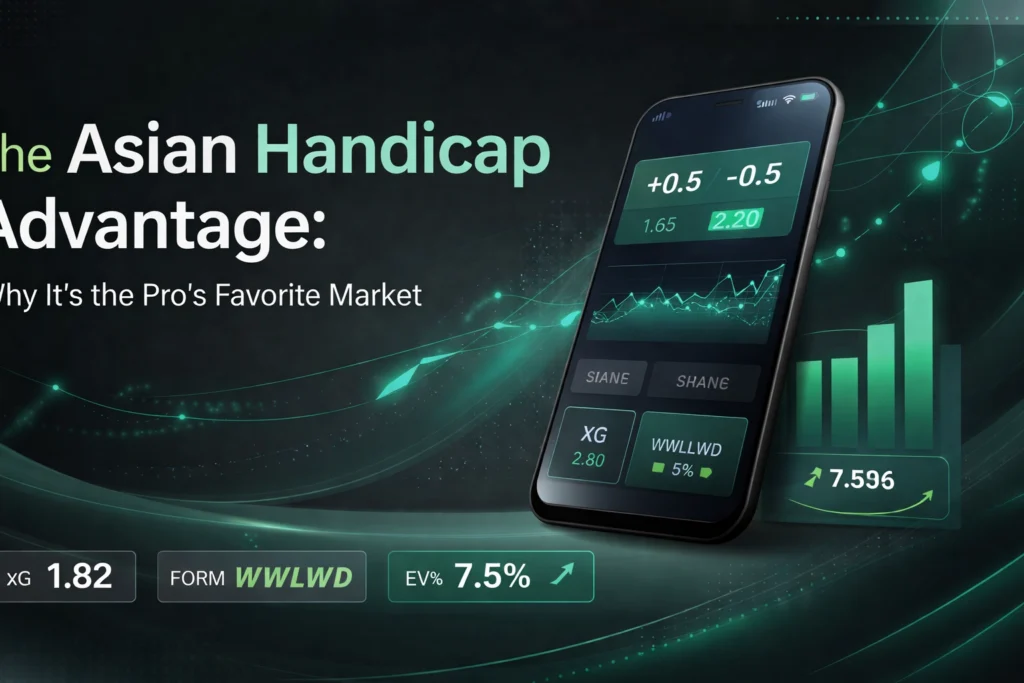
Walk into any serious betting syndicate or trading floor, and you’ll notice something. The screens aren’t showing 1X2 markets. The Asian Handicap Market is where they’re locked.
There’s a reason for that. And it’s not tradition.
Professional bettors gravitate toward Asian Handicaps because the market structure itself gives them an edge. Lower margins. No dead heat with the draw. Precision pricing that lets you exploit inefficiencies other markets simply don’t offer.
If you’ve been betting casually on match results and wondering why your returns feel flat, this might be the missing piece. Let’s break it down.
What Exactly Is an Asian Handicap?
At its core, an Asian Handicap removes the draw from the equation entirely.
In a traditional 1X2 market, you’re betting on three outcomes: home win, away win, or draw. That third option, the draw, creates problems. It adds uncertainty, inflates bookmaker margins, and forces you to spread your probability assessments across three outcomes instead of two.
Asian Handicaps solve this by applying a goal handicap to one team. The favourite gets a negative handicap (like -1.5), and the underdog gets a positive one (like +1.5). The match result is then adjusted by that handicap to determine your bet outcome.
No draw. Two outcomes. Cleaner decision-making.

The Mechanics: Half Goals, Quarter Goals, and Split Stakes
Here’s where it gets interesting, and where the real advantage lives.
Asian Handicaps use increments you won’t find in traditional markets:
- Half-goal lines (-0.5, -1.5, -2.5): These eliminate the possibility of a push entirely. You either win or lose.
- Whole-goal lines (-1, -2): These allow for a push (refund) if the match lands exactly on the handicap.
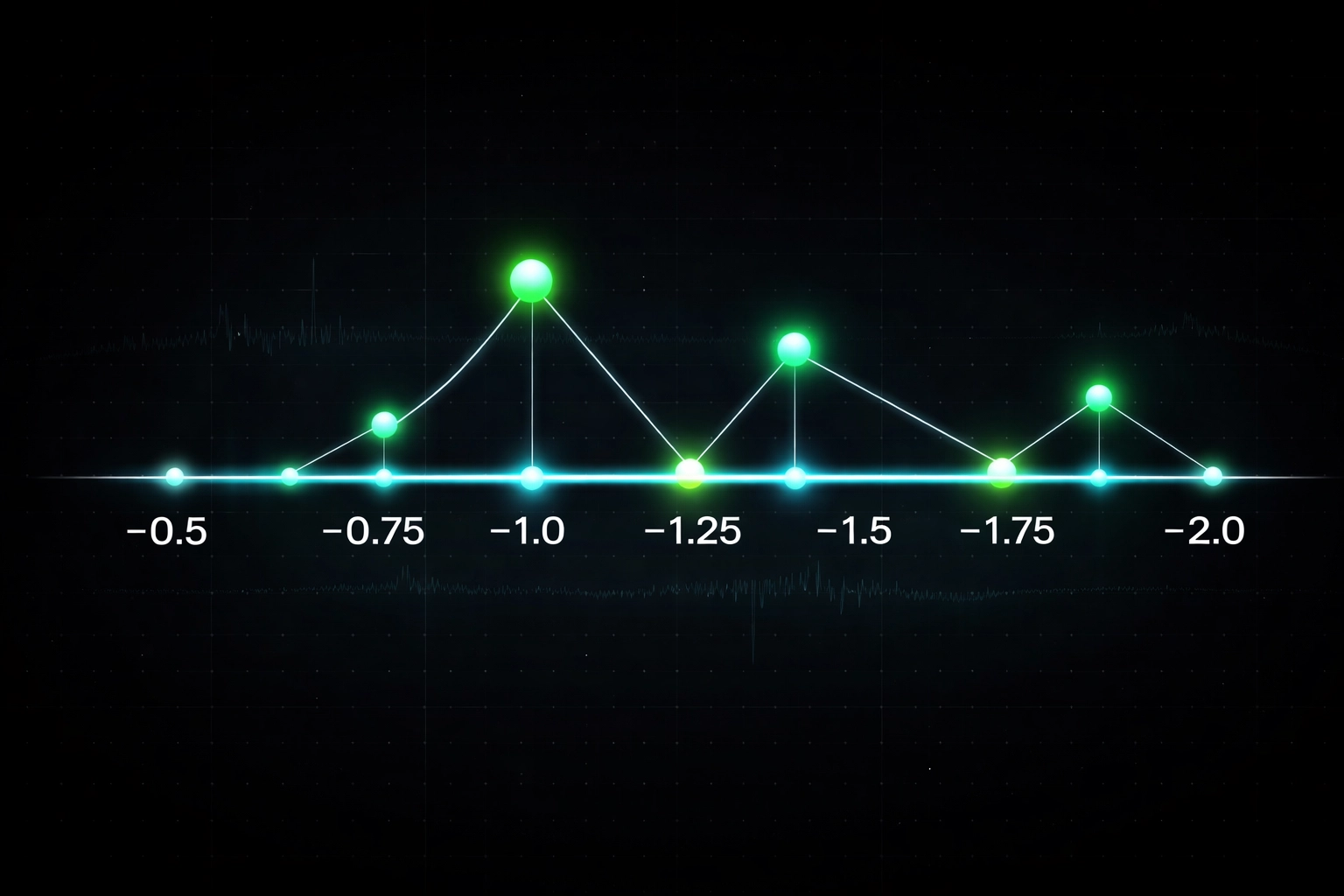
- Quarter-goal lines (-0.75, -1.25, -1.75): This is where it gets clever.
Quarter-goal lines split your stake between two adjacent handicaps. If you bet on -1.75, half your stake goes on -1.5 and half on -2.0. This creates four possible outcomes:
- Win both halves
- Win one half, push the other
- Lose one half, push the other
- Lose both halves
This granularity matters. It lets you find precise price points that match your probability model. And that precision is exactly what separates data-driven bettors from hobbyists.
Why the Margins Are Tighter
Bookmakers build their profit into the odds through something called the overround, the margin they add to ensure they profit regardless of outcome.
In a 1X2 market with three outcomes, there’s more room to hide that margin. The draw alone typically carries odds that favour the bookmaker disproportionately.
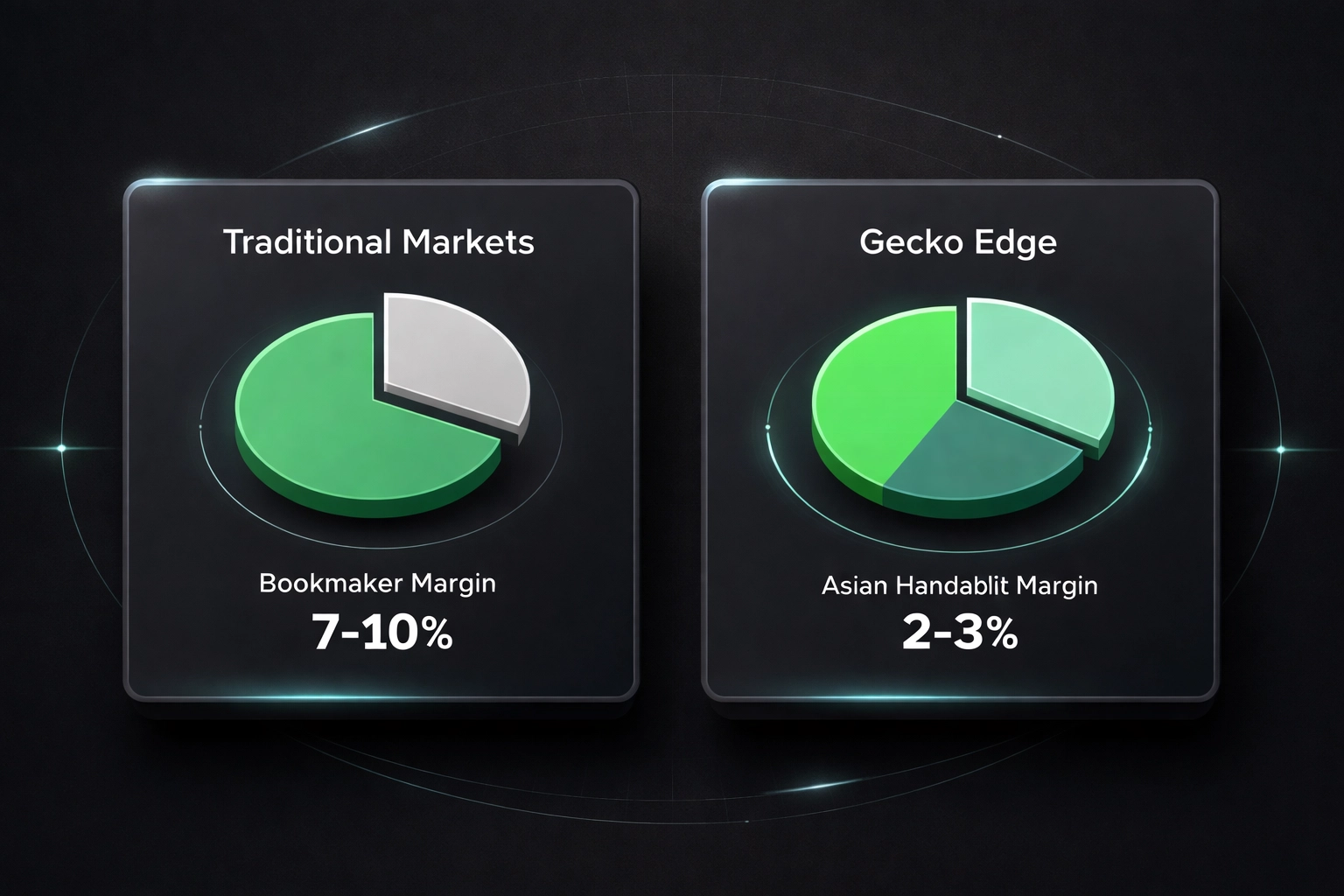
Asian Handicaps compress this. With only two outcomes and lines designed to sit near 50-50 probability, the odds typically fall in the 1.90 to 2.00 range. That’s close to a fair coin flip, which means less juice going to the bookmaker and more expected value available for you.
Over hundreds of bets, that difference compounds. A 2-3% margin reduction might sound small. It’s not. It’s the difference between a losing year and a profitable one.
EV Betting Calculations: Where the Edge Lives
Expected Value (EV) is the foundation of professional betting. It’s simple in theory:
EV = (Probability of Winning × Potential Profit) – (Probability of Losing × Stake)
If your EV is positive, the bet is worth making over time. If it’s negative, you’re bleeding money slowly.
Asian Handicaps make EV calculations cleaner for two reasons:
- Two outcomes instead of three simplifies your probability modelling
- Tighter margins mean your edge doesn’t get eaten by the bookmaker’s cut
Let’s say you’ve modelled a match and believe the favourite has a 55% chance of covering a -1.5 handicap. The bookmaker offers 1.95.
EV = (0.55 × 0.95) – (0.45 × 1) = 0.5225 – 0.45 = +0.0725
That’s a 7.25% edge per unit staked. Now imagine finding three or four of these per week using a tool like Gecko Edge that scans markets for exactly these discrepancies.
The maths works. But you need the right lines.
Risk Control: The Underrated Advantage
Professional bettors don’t just chase edge: they manage risk. Asian Handicaps offer built-in risk control mechanisms that traditional markets lack.
Quarter-goal lines reduce variance. Instead of an all-or-nothing result, you can structure bets where a narrow loss still returns half your stake. That smooths out your bankroll curve and reduces the emotional swings that lead to poor decisions.
Flexible positioning lets you hedge. If you’ve taken -1.0 and the match is heading toward a 1-0 finish, you can take +1.0 on the other side to lock in a small profit or minimise loss. The liquidity in Asian Handicap markets: especially on major leagues: makes this practical.
This kind of tactical flexibility is why syndicates prefer these markets. It’s not just about finding value. It’s about surviving long enough to realise that value.
Finding the Best Lines: Where Gecko Edge Comes In
Here’s the uncomfortable truth: knowing Asian Handicaps are better doesn’t help if you can’t find the best prices.
Lines vary across bookmakers. A -1.5 handicap at 1.90 with one bookmaker might be 1.95 with another. Over time, that 0.05 difference is the margin between profit and breakeven.
Gecko Edge is built for exactly this problem. It scans multiple markets, identifies discrepancies, and surfaces the bets where the expected value is genuinely positive: not just where the odds look appealing.
Instead of manually comparing lines across six different platforms, you get a single view of where the value actually sits. It’s the kind of edge that compounds quietly over a season.
If you’re serious about treating your betting like a data-driven operation, line shopping isn’t optional. It’s foundational.
Common Mistakes to Avoid
Even experienced bettors trip up on Asian Handicaps. A few things to watch:
Don’t confuse European and Asian Handicaps. European Handicaps still include the draw as a possible outcome. They’re not the same market, and the pricing reflects that.
Don’t ignore the push. Whole-goal lines can result in a refund. Factor that into your EV calculations: it changes the numbers.
Don’t bet without a model. Asian Handicaps reward precision. If you’re guessing at probabilities, you’re just gambling with extra steps. Build a system, test it properly, and trust the process.

The Bottom Line
Asian Handicaps aren’t exotic. They’re practical.
Two outcomes instead of three. Tighter margins. Granular lines that let you find precise value. Built-in risk management through split stakes. Better liquidity for in-play adjustments.
This is why professionals use them. Not because they’re complicated: but because they’re structurally better for anyone approaching betting with discipline and data.
The tools exist to make this easier. Gecko Edge helps you find the lines where the maths actually works in your favour. The rest is just execution and patience.
Start with the right market. Build from there.