

Signal vs. Noise; it is 11:30 am on a Saturday. Your phone is vibrating. A “tier-one” journalist on X has just posted a grainy photo of a star striker limping off the team bus. Five minutes later, a fan account claims the manager is planning a “radical tactical shift.” Within ten minutes, the odds for the away win begin to twitch.
As a bettor, you are at a crossroads. Do you follow the sudden market move? Do you trust the journalist? Or do you ignore it all and stick to your original pre-match analysis?
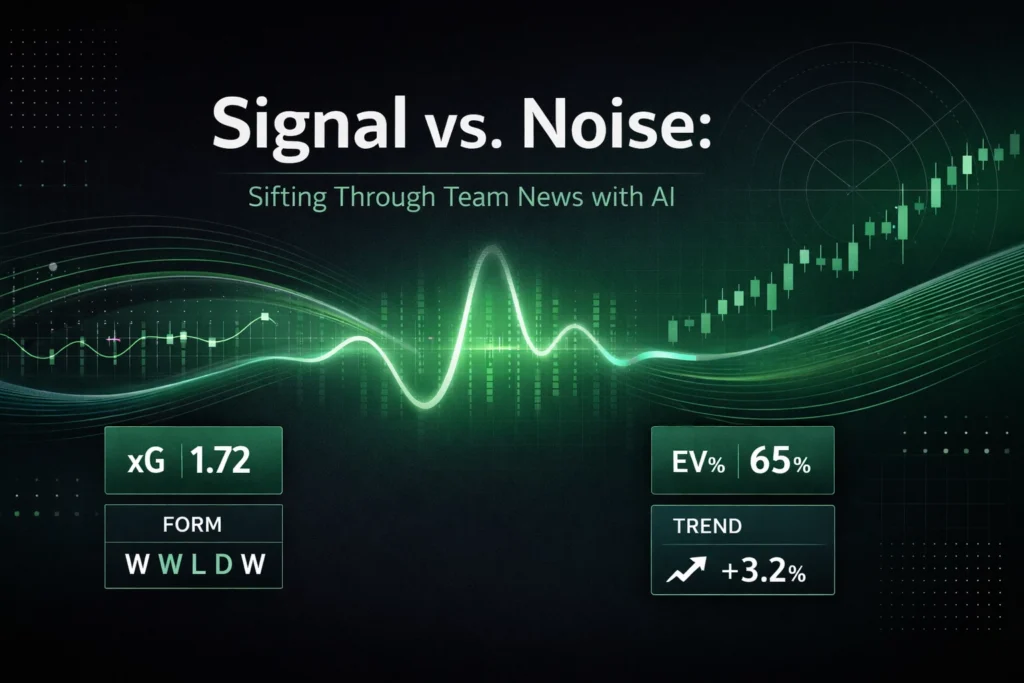
This is the daily struggle of the modern football trader: distinguishing the “signal” (information that actually changes the probability of an outcome) from the “noise” (distractions that feel important but have no statistical weight). In an era of information overload, the human brain isn’t equipped to process this volume of data objectively.
That is where Gecko Edge steps in. By leveraging predictive football models, we can strip away the emotional clutter and focus on what actually moves the needle.

The Paradox of Information
We live in an age where we have more access to data than any generation of bettors in history. We have heat maps, Expected Goals (xG), injury updates, and even biological data on players. Logic suggests that more information should lead to better decisions.
In reality, the opposite is often true. This is the “Information Paradox.” When we are flooded with data points, our cognitive biases take over. We look for information that confirms what we already want to believe (confirmation bias) or we give far too much weight to the most recent news we heard (recency bias).
In football, noise is everywhere. It’s in the post-match interview where a manager blames the referee. It’s in the social media frenzy over a player’s “unhappy” body language during training. None of this is quantifiable, yet it drives market prices every single weekend. To find true value, we must learn to ignore the drama and focus on the maths.
Defining the Signal
To understand how Gecko Edge works, we first have to define what a signal actually is. In the context of predictive football models, a signal is an input that has a statistically significant impact on the expected outcome of a match.
For example, a star player being sidelined is a signal. However, the strength of that signal depends on the quality of the replacement. If a top-tier striker is replaced by a backup with a similar xG-per-90-minute contribution, the “signal” might be much weaker than the news suggests. While the public panics and the price rises, the AI sees a negligible change in the win probability.

Why Social Media is Mostly Noise
Social media has transformed the speed of information, but it hasn’t necessarily improved its quality. For every legitimate injury leak, there are a dozen false rumours or exaggerated claims.
The problem is that the market reacts to everything. When a rumour gains traction, “the crowd” moves the price. If you are reacting to the same news as everyone else, you are already too late to find value. You are simply following the noise.
AI-powered solutions, such as those we develop at Gecko Edge, are designed to remain indifferent to the “mood” of the market. Our systems scan through incoming data, filtering out generic chatter and low-priority updates. By the time a rumour hits the mainstream, our predictive football models have already cross-referenced the news against historical data to determine if it’s worth acting on.
How Predictive Football Models Filter the Static
How does an AI actually tell the difference between a headline and a trend? It comes down to three core processes:
1. Automated Filtering
The AI scans thousands of sources simultaneously. It doesn’t just read the words; it looks for the source’s historical accuracy. It filters out non-relevant references and “filler” content that pollutes traditional searches. If a piece of news doesn’t meet a specific threshold of reliability or impact, it is discarded.
2. Intelligent Prioritisation
Not all news is created equal. A change in the weather forecast for an evening kick-off might have a higher impact on a “Total Goals” market than a minor injury to a second-choice goalkeeper. AI systems prioritise reports by relevance and actionability, surfacing only the highest-impact items. It’s about reducing the 8,000 reports you *could* read down to the 10 you *must* read.
3. Contextual Weighting
This is where Gecko Edge excels. When a “signal” is identified, it is immediately placed into the context of the model. If a key defender is out, the model doesn’t just say “that’s bad.” It calculates exactly how much that absence drops the team’s clean sheet probability based on the opposition’s attacking style.

The Role of Human Intuition
You might wonder if there is still a place for the “gut feeling” of a seasoned bettor. At Gecko Edge, we believe AI should be a mentor and a tool, not a total replacement for human logic.
The AI provides the clarity; you provide the intent. When the model highlights a discrepancy between the news and the price, it’s your job to execute with discipline. By removing the burden of data processing, you are free to focus on the higher-level strategy. You can read more about this balance in our guide on AI football predictions vs traditional tips.
Practical Application: Ask, Analyse, Act
To help you navigate the next matchday, we suggest a simple three-step framework for handling team news:
1. Ask: Where is this information coming from? Is it a primary source or an echo of someone else’s tweet? If it isn’t verified, it’s noise until proven otherwise.
2. Analyse: How does this news actually affect the probabilities? Don’t think in terms of “win or lose.” Think in terms of percentages. If a player is out, does the win probability drop by 2% or 10%? Our betting glossary can help you understand how to quantify these shifts.
3. Act: If the market has overreacted to the noise, there is value in going against the grain. If the market has ignored a genuine signal, there is value in moving early. If the price matches the new reality, the best action is often no action at all.

Smarter Betting Starts Here
The difference between a professional and an amateur isn’t the amount of information they have; it’s how they filter it. The professional looks for the signal. The amateur gets lost in the noise.
Using predictive football models allows you to step back from the chaos. It gives you the “quiet confidence” to ignore the headlines and trust the numbers. When you stop chasing every rumour and start following the data, the game changes.
At Gecko Edge, we aren’t just building software; we are building a better way to engage with the sports we love. We are cutting through the static so you can see the pitch clearly.
The next time your phone vibrates with “breaking news,” take a breath. Let the noise fade. Look for the signal. That is where the value lives.
Want to learn more about how we use technology to stay ahead? Explore our Knowledge Base or discover why Gecko Edge was built for bettors and powered by AI.