



Most punters rely on gut feeling or basic stats when placing football bets. Smart money uses mathematics. The Poisson model is one of the most powerful tools for predicting football scores and finding value in betting markets.
If you’ve ever wondered how professional bettors consistently find edges, this is one of their secret weapons. Let’s break down exactly how the Poisson model works, why it matters, and how you can use it to make better betting decisions.
What is the Poisson Model?
The Poisson model is a statistical method that predicts the probability of different scorelines in football matches. Named after French mathematician Siméon Denis Poisson, it calculates how likely each team is to score a specific number of goals.
The beauty lies in its simplicity. Football goals are relatively rare, random events. The Poisson distribution excels at modelling exactly these types of occurrences.
Instead of guessing whether Manchester United will beat Arsenal 2-1, you can calculate the actual probability of that exact scoreline. This transforms betting from guesswork into informed decision-making.

Why Football Betting Uses Poisson Models
Football matches produce perfect conditions for Poisson analysis. Goals happen independently, teams have measurable attacking and defensive strengths, and historical data provides reliable baselines.
The model works because it treats each goal as a separate event. When Liverpool scores their first goal, it doesn’t directly influence when they’ll score their second. This independence assumption holds reasonably well in football.
Professional bettors use Poisson models to:
- Calculate fair odds for any scoreline
- Identify overpriced outcomes in betting markets
- Build systematic approaches to goal markets
- Remove emotional bias from betting decisions
The mathematics gives you an edge that casual punters simply don’t have.
How to Calculate Poisson Probabilities
The Poisson formula looks intimidating but the process is straightforward once you break it down.
The Formula:
P(k) = (λᵏ × e⁻λ) / k!
Where:
- P(k) = probability of exactly k goals
- λ = expected number of goals
- e = mathematical constant (≈2.718)
- k! = k factorial
Step 1: Calculate League Averages
Start with the current season’s data. Calculate:
- Average home goals per game
- Average away goals per game
- These become your baseline expectations
Step 2: Determine Team Strengths
For each team, work out:
- Attack strength = (Goals scored ÷ Games) ÷ League average
- Defence strength = (Goals conceded ÷ Games) ÷ League average
A team with 1.2 attack strength scores 20% more goals than average. A team with 0.8 defence strength concedes 20% fewer goals than average.
Step 3: Calculate Expected Goals
Expected home goals = Home attack × Away defence × League home average
Expected away goals = Away attack × Home defence × League away average
Step 4: Apply the Formula
Use your expected goals as λ and calculate probabilities for 0, 1, 2, 3, 4+ goals for each team.
Let’s say Manchester City expect 2.1 goals against Brighton’s 0.8 goals. Using Poisson:
- City 0 goals: 12.3%
- City 1 goal: 25.8%
- City 2 goals: 27.1%
- City 3 goals: 18.9%
Multiply these probabilities together to get exact scoreline odds.
Real Betting Market Applications
The Poisson model’s true power emerges when you apply it to actual betting markets.
Over/Under Goals Markets
Add up all scoreline probabilities that exceed your target. For Over 2.5 goals, calculate every combination where total goals ≥ 3.
If Poisson suggests 58% probability for Over 2.5 goals but bookmakers offer odds implying only 52%, you’ve found value.
Asian Handicap Betting
Poisson excels at Asian Handicap markets. When you give one team a virtual head start, the model quickly calculates new winning probabilities.
Brighton +1.5 vs City means Brighton wins if they lose by one goal or less. Sum up all relevant scoreline probabilities to find the true edge.
Both Teams to Score (BTTS)
Calculate the probability each team scores zero goals. BTTS “No” equals the probability one or both teams blank. BTTS “Yes” is everything else.
Exact Score Markets
This is where Poisson truly shines. Bookmakers often misprice specific scorelines, especially in lower-profile matches.
A Poisson model might show 1-0 home wins at 8% probability while bookmakers offer 15/1 odds (6.7% implied). That’s potential value worth exploring.
Common Mistakes to Avoid
Using Outdated Data
Team strength changes throughout seasons. Update your calculations regularly, especially after transfer windows or managerial changes.
Ignoring Sample Sizes
Early season data lacks reliability. Wait for at least 8-10 games before trusting Poisson predictions fully.
Treating All Goals Equally
A penalty goal and a 30-yard screamer both count as one goal, but they reflect different underlying processes. Consider adjusting for penalty frequencies.
Forgetting About Context
Poisson assumes constant conditions. Cup finals, relegation battles, and end-of-season dead rubbers create different dynamics than normal league matches.
Over-Betting Small Edges
A 2% edge doesn’t justify large stakes. Stick to disciplined bankroll management even when mathematics supports your position.
When Poisson Models Fail
No model is perfect. Poisson analysis struggles in several scenarios:
High-Scoring Matches
The model assumes low-scoring affairs. Basketball or rugby produce too many scores for Poisson to handle effectively.
Early Season Chaos
New signings, tactical changes, and fitness levels create unpredictable variables that historical data can’t capture.
Motivation Mismatches
A team fighting relegation plays differently than one already safe. Cup competitions versus league matches demand different approaches.
In-Play Situations
Once matches start, team tactics, red cards, and momentum shifts make pre-match Poisson calculations obsolete.
How AI Enhances Poisson Analysis
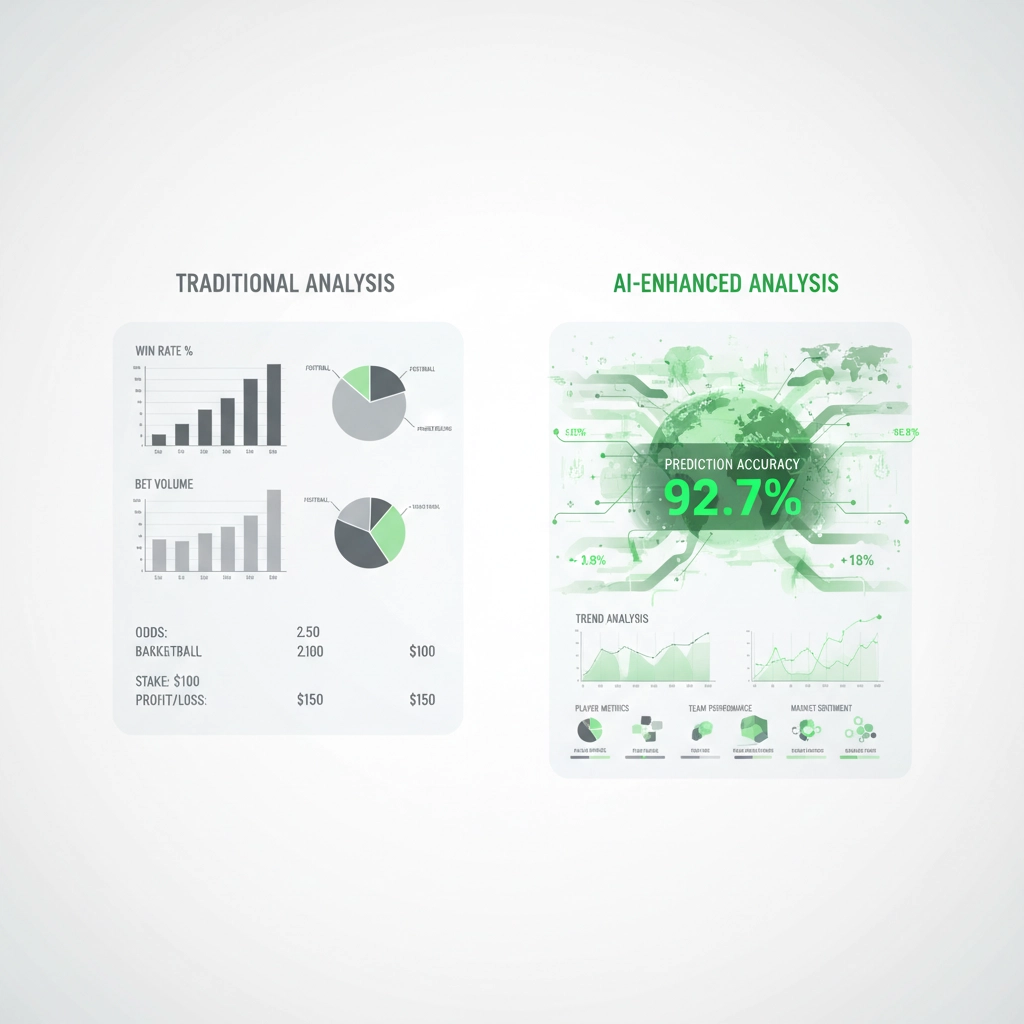
Traditional Poisson models use basic attack and defence ratings. Modern AI systems like Gecko Edge incorporate dozens of additional variables.
Advanced algorithms consider:
- Recent form weighted by opposition strength
- Player availability and injury impacts
- Tactical matchups and playing styles
- Weather conditions and venue factors
- Referee tendencies and historical patterns
Gecko Edge processes thousands of data points in real-time, constantly updating predictions as new information emerges. Where traditional Poisson might suggest Manchester United score 1.8 goals, AI-enhanced models account for Bruno Fernandes being suspended or playing in heavy rain.
The mathematics remains the same. The inputs become dramatically more sophisticated.

Building Your Poisson Betting Strategy
Start simple. Calculate basic attack and defence ratings for your favorite league. Build scoreline probability matrices for upcoming matches.
Compare your odds with bookmaker prices. Look for discrepancies of 5% or more before considering bets.
Focus on markets where bookmakers struggle most:
- Exact scores in lower divisions
- Goal ranges (2-3, 4-6 total goals)
- Team goal handicaps
Track your results religiously. Poisson betting succeeds over hundreds of matches, not individual weekends.
Most importantly, remember that mathematics gives you an edge, not a guarantee. Even perfect analysis loses sometimes.
The goal isn’t winning every bet. It’s finding consistent value that compounds over time.
Smart betting starts with understanding the underlying probabilities. Poisson models provide exactly that foundation.