



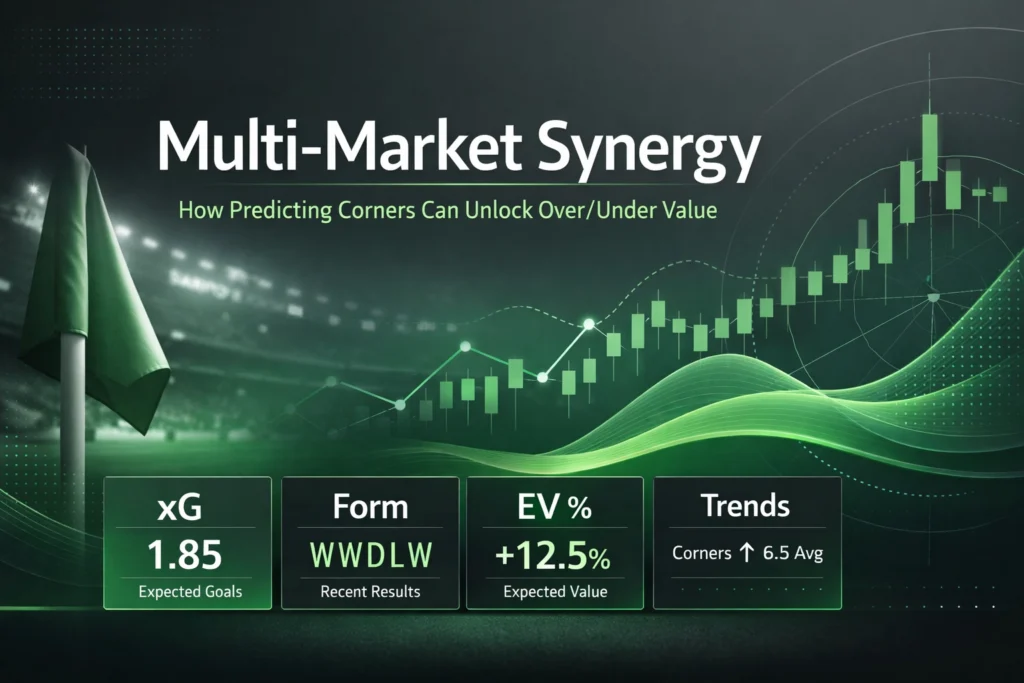
Most bettors treat corners and goals as separate markets. That’s a mistake. They’re connected in ways that create genuine value if you know where to look.
Corners aren’t just random set pieces. They’re a measure of sustained attacking pressure. And sustained attacking pressure, more often than not, leads to goals. The trick is understanding when that correlation is strong enough to exploit across multiple markets.
The Corners-to-Goal Pipeline
Think about how a match unfolds when one team dominates possession and territory. They push forward, pin the opposition back, create half-chances. Most of those attacks end in corners rather than clear shots.
But here’s what matters: teams that win a lot of corners are spending significant time in the attacking third. They’re creating situations. Eventually, one of those situations converts.
The data backs this up. Matches with 12+ total corners tend to produce more goals than matches with fewer than 8 corners. It’s not a perfect correlation, but it’s statistically meaningful enough to build a strategy around.
Gecko Edge tracks this relationship in real-time, monitoring corner counts against expected goals and live match pressure metrics. When the numbers align, it flags opportunities before the market adjusts.

Why Bookmakers Miss This Connection
Most bookmakers price the Over/Under goals market based on team form, head-to-head records, and xG models. They do factor in attacking style, but they rarely weight in-play corner accumulation as heavily as they should.
That creates a timing advantage. If you’re watching corners pile up in the first 30 minutes, you can assess the Over 2.5 goals market before it tightens. The bookmaker might still have it at decent odds because the score is 0-0, but the underlying match state tells a different story.
Let’s say Brentford is playing Brighton. Both teams average high corner counts. The match starts cagey, still 0-0 at 25 minutes, but there have already been 7 corners. The pressure is building. One team is camping in the opposition half.
At this point, the Over 2.5 goals market might still be available at reasonable value because the scoreline hasn’t moved. But the corner count is screaming that goals are coming. That’s your window.
Practical Example: Finding Value Through Corners Data
I’ll give you a real scenario. Serie A match, Atalanta hosting Sassuolo. Both teams play open, aggressive football. Both teams concede space in defensive transitions.
Pre-match corner lines suggested 10+ total corners. The Over 2.5 goals market was priced at around 1.75. Not terrible, but not exceptional value either.
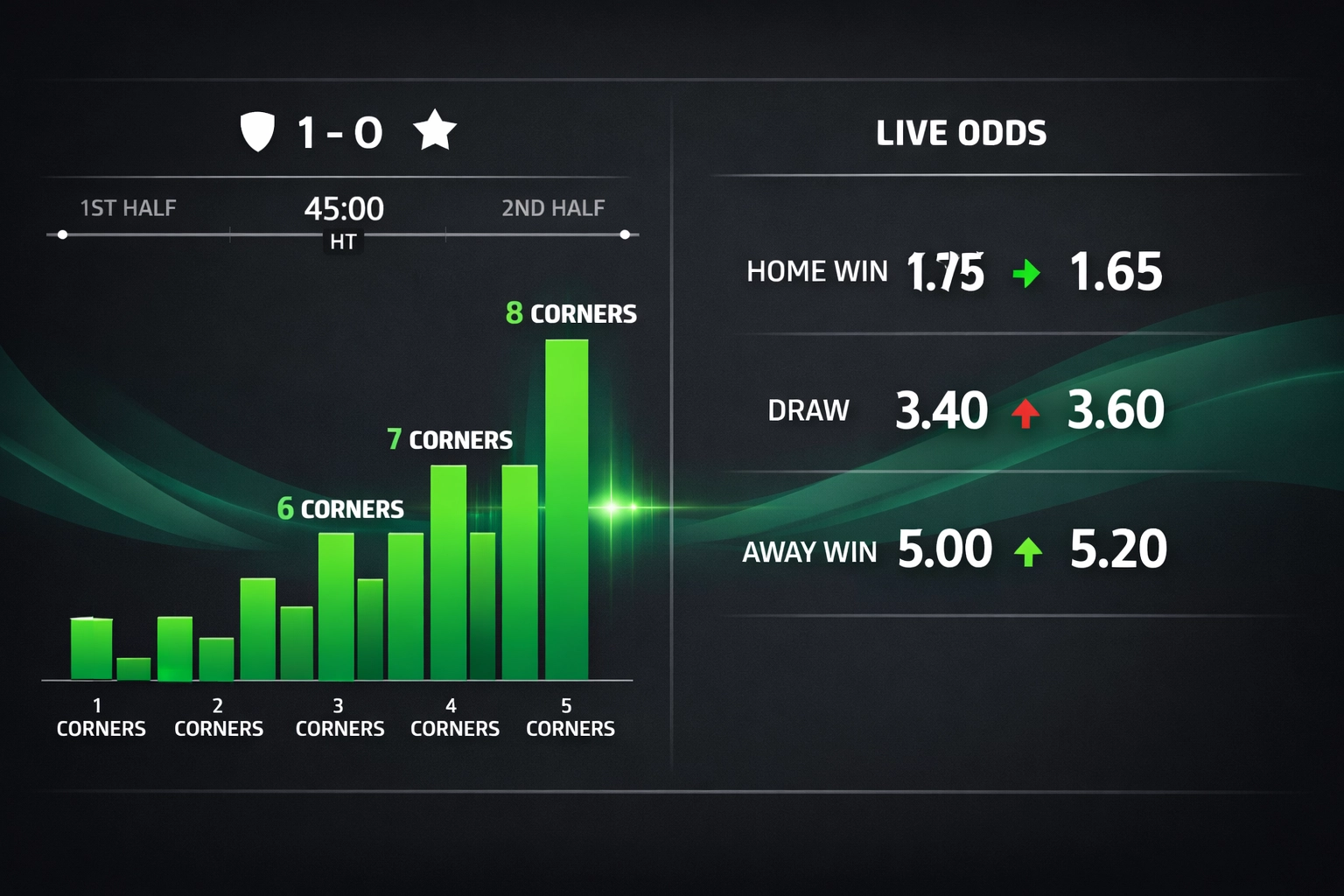
The match kicks off. Atalanta dominates early. Five corners in the first 18 minutes. Still 0-0 on the scoreboard.
At this point, Gecko Edge would flag two things: corner accumulation above expected rate, and sustained territorial pressure. The Over 2.5 goals market is still around 1.80 because no goals have been scored yet.
By the 35th minute, it’s 8 corners, still 0-0. Then the breakthrough: Atalanta scores from open play. Suddenly the Over market drops to 1.50. But you’re already in at 1.80.
The match finishes 3-1. Four goals. The early corner data gave you the edge before the scoreline caught up with the match reality.
When the Strategy Works Best
This approach isn’t universal. It works in specific match contexts:
Open games with high attacking intent. If both teams are sitting deep and playing cautiously, corners don’t mean much. But in matches where both sides are committing men forward, corner accumulation is a leading indicator.
Matches involving teams with poor defensive set-piece records. If a team concedes frequently from corners, high corner counts become even more valuable. You’re not just betting on open play goals, you’re also betting on direct corner conversions.
Second halves after active first halves. If the first half produces 8+ corners and 1-2 goals, the second half often continues at the same intensity. Tired defenders, stretched formations, more space. That’s when corner data compounds.
Gecko Edge identifies these contexts automatically. It filters matches by corner propensity, defensive vulnerability, and in-play pressure metrics. You’re not manually crunching numbers. The system highlights matches where the multi-market synergy is strongest.
Multi-Market Coverage: Beyond Just Goals
The corner-to-goal relationship isn’t limited to Over/Under markets. You can apply the same logic to BTTS, Asian Handicaps, and even next goal markets.
If one team is winning 8 corners and the other has 2, but the score is still 1-1, the team with corner dominance is more likely to score next. That information helps you position in the live Asian Handicap market before the odds shift.
Similarly, if both teams are generating corners at both ends, BTTS becomes more likely. Corners suggest attacking presence. If both teams are winning corners, both teams are creating situations.
Gecko Edge handles this complexity through multi-market monitoring. It doesn’t just track corners in isolation. It tracks how corner data interacts with live odds across goals, handicaps, and team totals. That’s the synergy.
You’re not betting corners. You’re using corners as a lens to find mispriced goal markets.

The Timing Element
The biggest mistake bettors make with this strategy is entering too late. By the time a match has 10 corners and 2 goals, everyone can see it’s open. The market has already adjusted.
You need to enter when corner accumulation is high but the scoreline is still low. That’s the value window. It usually exists between the 20th and 40th minute, or early in the second half if the first half was active.
After that, the bookmakers catch on. Odds shorten. The value disappears.
That’s why real-time data matters. Manual tracking doesn’t work. By the time you notice the pattern, the moment has passed. AI-driven systems like Gecko Edge process this information instantly, flagging opportunities the moment the data aligns.
Building a Corners-to-Goal System
If you want to run this strategy consistently, you need a framework. Here’s what to track:
Total corners in the first 30 minutes. Anything above 6 is notable. Above 8 is significant.
Corner differential. If one team has 7 corners and the other has 1, expect the dominant team to convert pressure eventually.
Expected goals relative to corner count. High corners but low xG suggests poor final execution. High corners with rising xG is the sweet spot.
Team-specific corner conversion rates. Some teams score from corners regularly. Others waste them. Know the difference.
Gecko Edge integrates all of these factors into predictive models that update live. You don’t need spreadsheets or manual logs. The system tracks, calculates, and alerts. You just decide when to act.
Common Pitfalls
This strategy isn’t foolproof. Corners can pile up without goals if finishing is poor or if the goalkeeper has an outstanding match. That’s variance. You manage it through volume and selection.
Don’t force it in matches with low corner propensity. Don’t chase it when the market has already adjusted. And don’t ignore the broader match context. Corners are a signal, not a guarantee.
The edge exists because most bettors overlook the relationship. They see corners and goals as separate. They wait for goals before betting goals. By then, it’s too late.
You’re looking earlier. You’re connecting data points others miss. That’s where value lives.
Why AI Makes This Easier
Manually tracking corners across multiple live matches isn’t realistic. You’d need six screens and perfect focus. Even then, you’d miss opportunities because you can’t process everything fast enough.
AI handles the heavy lifting. It monitors every match, tracks corner counts, correlates them with pressure metrics and expected goals, and flags situations where the data suggests value.
Gecko Edge was built for exactly this kind of multi-market analysis. It doesn’t just track one variable. It tracks how different markets interact, identifies inefficiencies, and presents opportunities in a way that’s actually usable.
You’re not drowning in data. You’re getting clarity.
That’s the point. Not more information. Better information. Delivered when it matters.
Multi-market synergy isn’t complicated. It’s about seeing connections others miss. Corners to goals. Pressure to results. Data to value. When you understand the relationships, the opportunities become obvious.