

The “Both Teams to Score” (BTTS) market is one of the most popular in football betting. It is easy to understand, provides interest until the final whistle, and feels intuitive. If two high-scoring teams meet, they should both find the net, right?
Not exactly. Relying on intuition in a high-variance market like BTTS is a quick way to deplete a bankroll. The professional approach: the quant approach: requires us to move past “feelings” and look at the underlying maths that drive goal production.
At Gecko Edge, we believe that smarter betting starts with clarity. To find value in BTTS, you need to strip away the noise of the crowd and focus on the data points that actually correlate with goals at both ends of the pitch.
The Illusion of “High-Scoring” Teams
Most casual bettors look at a league table and see which teams have the most goals. They assume that if Team A and Team B score frequently, the “Yes” outcome for BTTS is a certainty. This is a surface-level analysis.
A team might score four goals in one match and zero in the next three. Their average looks high, but their consistency is low. A quant looks for scoring frequency and defensive vulnerability in tandem. We aren’t just looking for teams that score; we are looking for teams that cannot help but concede.
The real edge is found in the discrepancy between public perception and statistical reality. When the market overvalues a big-name striker but ignores a structural weakness in a mid-table defence, that is where we find our entry point.

The Metric of Truth: Expected Goals (xG)
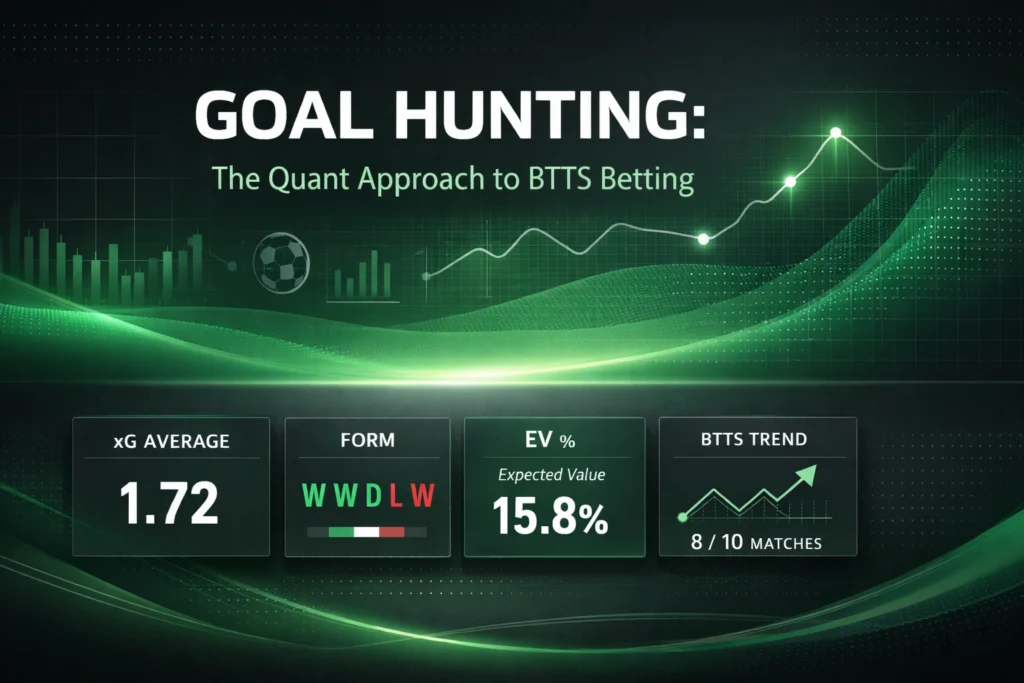
If you want to treat betting as a serious endeavour, you must embrace Expected Goals (xG). For the uninitiated, xG measures the quality of a chance based on historical data. It tells us how many goals a team should have scored based on the positions and types of shots they took.
In the context of BTTS, we look at two specific subsets:
- xG For (Offensive Efficiency): Is the team creating high-probability chances, or are they relying on 30-yard screamers that rarely go in?
- xG Against (Defensive Fragility): Is the team’s defence actually solid, or have they just been lucky that opposition strikers are having an off day?
When we use the tools at Gecko Edge, we look for “Negative Variance.” This occurs when a team has high xGA (Expected Goals Against) but hasn’t actually conceded many goals yet. The maths suggests their luck is about to run out. If they are facing an opponent with a clinical xG For rating, the probability of both teams scoring spikes significantly.
Defensive Fractals and Clean Sheet Probability
To find a winning BTTS bet, you are essentially betting against a clean sheet for both sides. Therefore, the quant approach must involve an analysis of defensive structures.
We look at “Defensive Fractals”: patterns in how a team concedes. Do they struggle with set pieces? Are they vulnerable to fast counter-attacks? Some teams have a high “Floor” but a low “Ceiling” defensively. They might not get hammered 5-0, but they almost always concede one.
A “leaky” defence isn’t just one that is bad; it’s one that is systematically compromised. By identifying these patterns, Gecko Edge allows bettors to move beyond basic AI betting tips and into the realm of high-probability forecasting.

The Impact of Game State
The scoreline at any given moment: the “Game State”: dictates how teams play. A team leading 1-0 in the 70th minute might sit back and defend, while the trailing team pours players forward. This is the “Chaos Factor” that makes BTTS so exciting, but it can also be quantified.
We analyse how teams react to being behind. Some teams possess a “high-pressure” DNA. When they concede, their offensive output increases exponentially as they chase the game, which in turn leaves their defence even more exposed. This “seesaw” effect is a goldmine for BTTS hunters.
If our data shows that Team A frequently scores late goals when trailing, and Team B has a history of failing to keep clean sheets when under pressure, the “Yes” bet becomes mathematically sound. You can learn more about these dynamics in our AI betting education section.
Contextual Variables: Home vs. Away
The venue matters, but not for the reasons most think. It isn’t just about “home-field advantage.” It’s about tactical shifts.
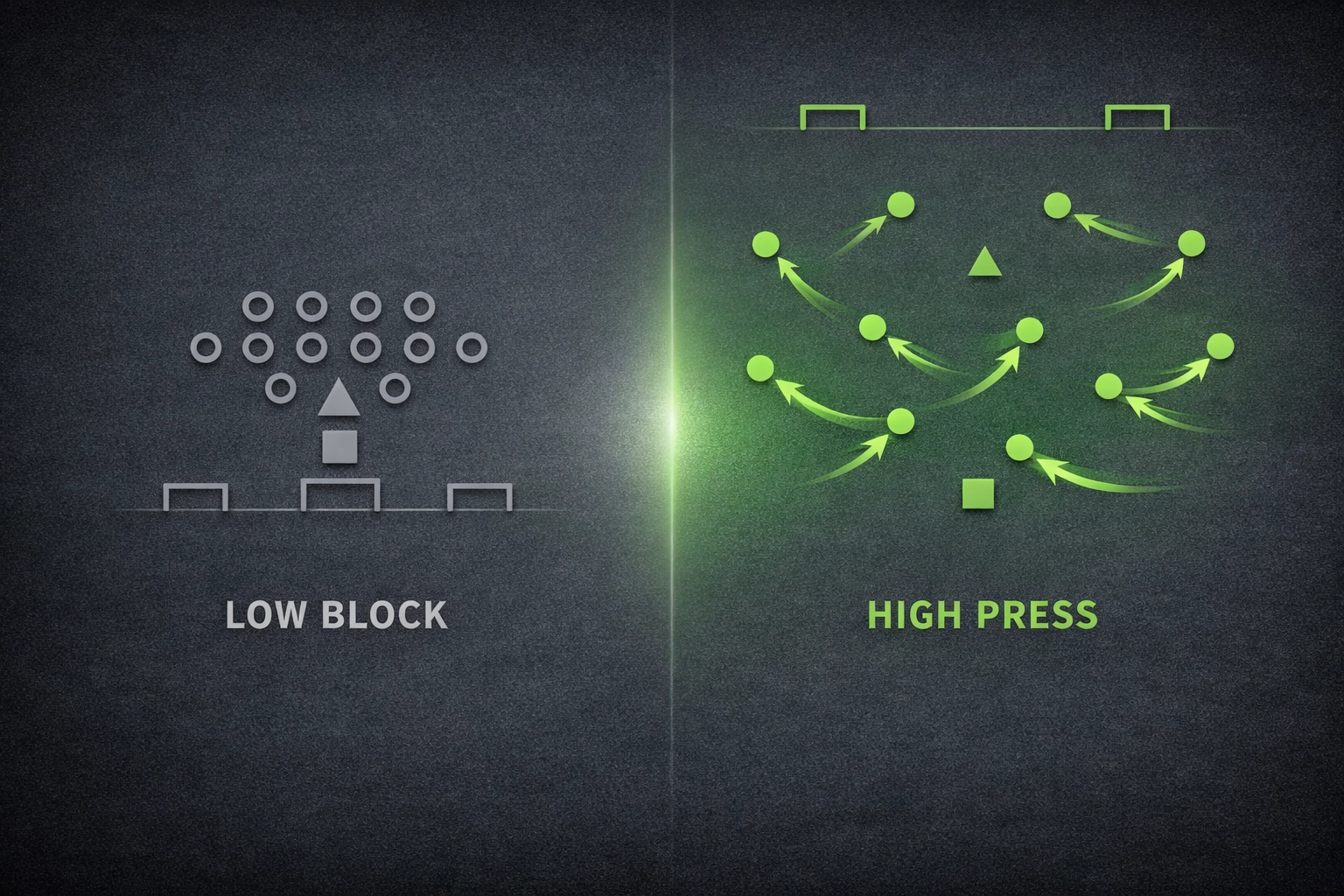
Many mid-table teams play a conservative 4-5-1 away from home, looking to nick a draw. At home, under pressure from their own fans, they might switch to a more expansive 4-3-3. This transition changes their scoring and conceding probabilities.
A quant approach ignores the “atmosphere” and focuses on the tactical shift. We look at the delta between a team’s xG at home versus their xG on the road. If a team’s defensive discipline dissolves when they try to play offensive football at home, they become a prime candidate for a BTTS bet.
Why AI is the Ultimate Goal Hunter
The sheer volume of data in modern football is overwhelming for a human. There are thousands of matches across hundreds of leagues every month. Attempting to manually calculate the xG, defensive variance, and tactical shifts for every match is impossible.
This is where Gecko Edge changes the game. Our AI models process millions of data points in seconds. They don’t get tired, they don’t have “favourite teams,” and they don’t suffer from the gambler’s fallacy.
“Built For Bettors, Powered By AI” isn’t just a slogan; it’s our methodology. The AI identifies the subtle links between a team’s passing accuracy in the final third and their opponent’s tendency to lose headers in the box. It finds the goals before they happen.
Discipline and the Long Game
A quantitative approach requires a shift in mindset. You will have days where the data is perfect, the maths is sound, and the match ends 0-0. That is the nature of sport.
The goal isn’t to win every bet; the goal is to place bets where the probability of the outcome is higher than the odds offered by the bookmaker. If the bookie offers odds that imply a 50% chance of BTTS, but our Gecko Edge models show a 65% probability, that is a value bet. Over a hundred bets, the maths will win. Over a thousand, it becomes a certainty.
Professional betting is about finding an edge and exploiting it with clinical discipline. Avoid the hype of the “big match” and focus on the numbers. You can find more structured advice in our knowledge base.

Summary: Ask, Analyse, Act
To succeed in the BTTS market, follow this simple framework:
- Ask: Does the market price reflect the true probability of goals?
- Analyse: Use xG, defensive variance, and game state data to find the reality behind the scorelines.
- Act: Place the bet only when the data confirms an edge.
The quant approach isn’t about predicting the future; it’s about understanding the probabilities of the present. By leveraging the power of Gecko Edge, you stop guessing and start calculating.
The goals are out there. You just need the right tools to find them. For those ready to take their strategy to the next level, our blog is packed with deep dives into other markets and methodologies.
Smarter betting starts here. Let the maths do the heavy lifting.