


Let’s cut through the noise straight away. The “secrets” everyone talks about aren’t really secrets anymore. The $60 billion AI betting market isn’t hiding revolutionary techniques from you. What’s happening is far more interesting: and practical: than any conspiracy theory.
Here’s what’s actually going on behind the scenes.
The Death of Traditional Tipsters
Traditional football tipsters are drowning. Not because they’re bad analysts, but because they’re using stone-age tools in a space-age game.
Most tipsters still rely on form guides, team news, and gut instinct. They might throw in some basic stats: goals scored, clean sheets, recent results. That approach worked when everyone else was doing the same thing.
Now they’re competing against AI models that process 200+ variables per match in real-time. Expected goals, defensive actions, ball progression metrics, weather data, referee tendencies, even social media sentiment around team selections.
The accuracy gap is brutal. Traditional methods hit around 50-60% on match predictions. Modern AI systems consistently achieve 75-85% accuracy across major leagues.

It’s not about intelligence or football knowledge. It’s about processing power and data depth. You wouldn’t use a calculator to compete with a computer in maths. Same principle applies here.
What AI Betting Models Are Actually Optimising For
Here’s where it gets interesting. Most punters think AI models just predict winners and losers. That’s kindergarten-level thinking.
Advanced AI betting systems optimise for three core metrics:
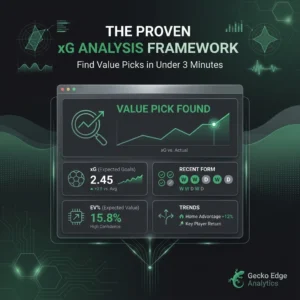
Expected Value (EV) – Finding bets where the true probability differs significantly from the bookmaker’s implied probability. A 60% chance priced at 40% creates massive long-term profit.
Market inefficiencies – Identifying when sportsbooks haven’t adjusted their lines fast enough to reflect new information. Team news, weather changes, late injury updates.
Dynamic adaptation – Adjusting strategies based on how markets move. If Asian Handicap lines shift but BTTS odds remain static, there’s usually a reason worth exploring.
Gecko Edge processes these calculations in real-time, giving you the same analytical firepower that professional syndicates use.
The Value Betting Revolution
Traditional betting advice focuses on picking winners. AI-powered betting focuses on finding value.
Here’s a simple example. Liverpool are playing Brighton. The bookmaker prices Liverpool at 1.30 (77% implied probability). Your AI model calculates Liverpool’s true chance at 85%.
That 8% difference represents genuine value. Over hundreds of similar bets, that edge compounds into serious profit.
Most punters never spot these opportunities because they’re looking at the wrong metrics. They see Liverpool’s recent form, Salah’s goal record, Brighton’s defensive struggles. All surface-level analysis.
AI digs deeper. Pressing intensity metrics. Set-piece conversion rates against specific defensive setups. Historical performance in similar game states.

In-Play Adaptivity: Where Real Money Gets Made
Pre-match betting is just the warm-up act. The main event happens during the 90 minutes.
Live betting markets move constantly. A yellow card changes the dynamic. A tactical substitution shifts the balance. Weather conditions affect playing styles.
Traditional bettors can’t process these variables fast enough. By the time they’ve assessed the impact of a red card, the odds have already moved.
AI systems adapt in real-time. They know that Brighton become 23% more dangerous in the final 15 minutes when trailing by one goal. They recognise that Liverpool’s pressing drops by 18% after the 75th minute in away games.
Gecko Edge tracks these micro-patterns across thousands of matches, identifying profitable opportunities the moment they appear.
Market Manipulation vs Market Efficiency
Here’s something most betting education doesn’t cover. Sportsbooks aren’t trying to predict exact scores. They’re trying to balance their books and maximise profit.
This creates systematic inefficiencies that AI can exploit.
When Manchester United play Arsenal, casual money floods in on both sides. The bookmaker adjusts odds to manage liability, not reflect true probability. Smart AI systems identify when public sentiment has skewed the lines away from statistical reality.
The “secret” isn’t some hidden formula. It’s understanding that betting markets are driven by human psychology and bookmaker profit margins, not pure mathematical probability.

Common Misconceptions That Cost Money
“AI picks are always better” – Wrong. AI provides better data analysis. You still need to interpret the information and manage your bankroll properly.
“More data equals better predictions” – Quality over quantity. The right 20 variables matter more than 200 irrelevant ones.
“AI removes all risk” – Nothing removes risk. AI helps you make more informed decisions with better long-term expected value.
“You need massive stakes to profit” – Value betting works at any stake level. A 3% edge on £10 stakes compounds just as effectively as on £1,000 stakes.
The Practical Implementation Framework
Getting started isn’t complicated, but it requires discipline.
Step 1: Focus on value, not outcomes. A losing bet with positive expected value is better than a winning bet with negative expected value.
Step 2: Track everything. Your betting history, market movements, model accuracy. Data reveals patterns that intuition misses.
Step 3: Start small. Test strategies with minimal stakes until you understand how the systems work.
Step 4: Specialise initially. Master Premier League betting before expanding to Championship or European leagues.

What Sportsbooks Don’t Want You to Know
Bookmakers make money from recreational punters who bet on emotion, back favourites blindly, and chase losses with bigger stakes.
They’re less keen on customers who:
- Consistently find value bets
- Use AI-powered analysis tools
- Bet systematically rather than emotionally
- Focus on long-term profit over short-term excitement
Some operators limit successful players. Others welcome them because sharp money helps set more accurate lines.
The key is flying under the radar. Consistent small profits attract less attention than spectacular wins and losses.
The £60 Billion Reality Check
The AI betting market is projected to hit £60 billion by 2034. That growth isn’t driven by secrecy or manipulation. It’s driven by effectiveness.
AI tools democratise professional-level analysis. What previously required expensive data feeds and custom algorithms is now accessible through platforms like Gecko Edge.
The “secret” is that there are no secrets. Just better tools, clearer thinking, and more systematic approaches to finding value in football betting markets.
The question isn’t whether AI will dominate sports betting. It already does.
The question is whether you’ll adapt or get left behind.

Smart money follows the data. Everything else is just noise.