The short answer
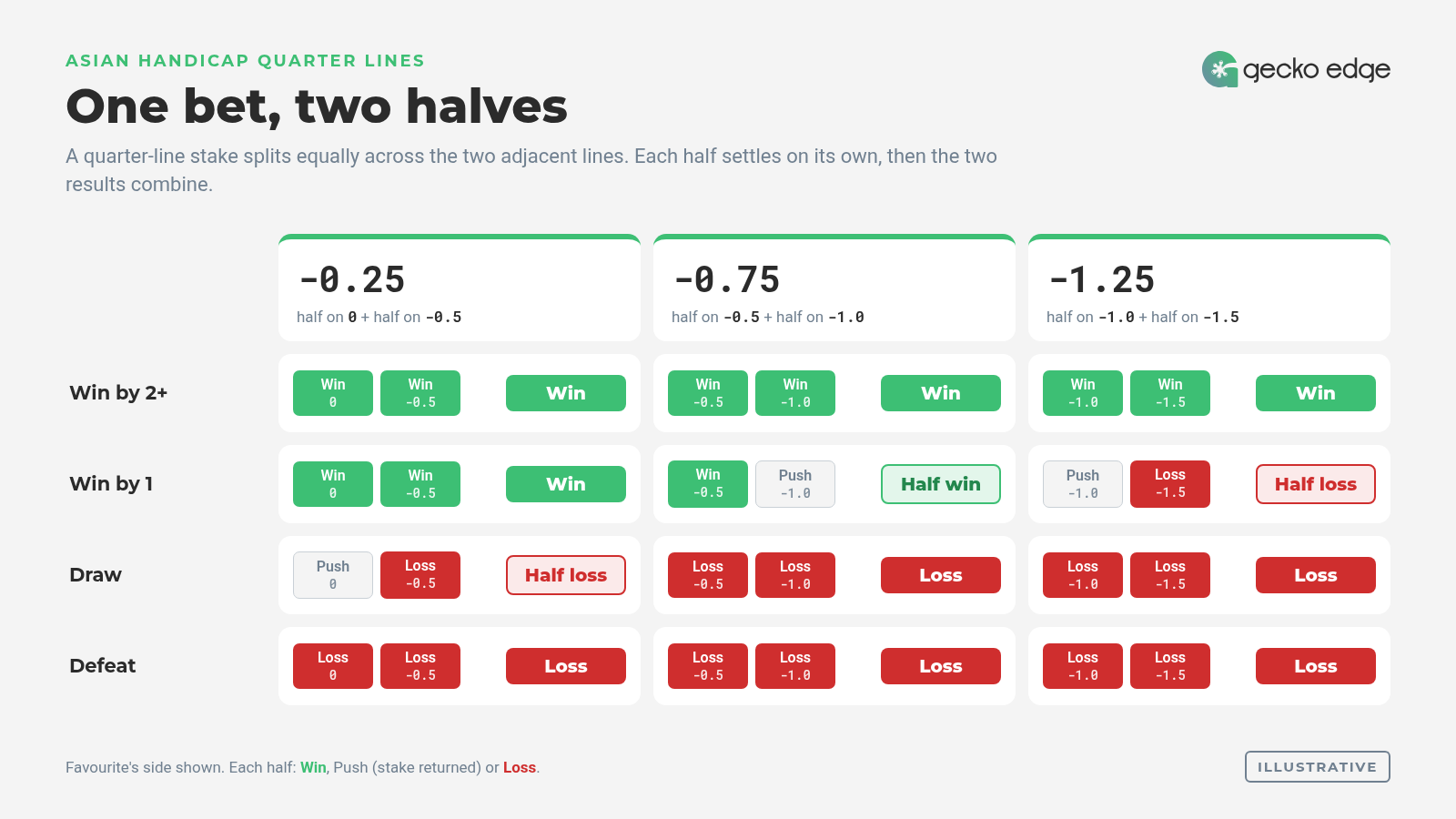
A quarter-line Asian Handicap splits your stake into two equal bets on the two lines either side of it. A bet at -0.75 is half at -0.5 and half at -1.0. Because each half settles on its own, the bet can win in full, win half, lose half or lose in full.
This guide gives you a settlement table for every common quarter line, worked examples, and a clear method for judging whether a quarter-line price is fair. If you are new to handicaps in general, start with our ultimate guide to Asian Handicap betting, then come back here for the quarter lines.
How a quarter line works: one bet, two halves
A quarter line always sits halfway between a whole line and a half line. -0.25 sits between 0 and -0.5. -0.75 sits between -0.5 and -1.0. -1.25 sits between -1.0 and -1.5. When you place 10 units on a quarter line, the bookmaker treats it as 5 units on each of the two neighbouring lines, both at the same quoted price.
The quick settlement method
Use the same three steps for every quarter line:
Gecko Edge has tracked 8,439 AI-generated bets and recorded +398pts of profit across 66 competitions. See how the model works →
- Split the line. Write down the two lines either side of it. For -0.75, that is -0.5 and -1.0.
- Apply each handicap to the goal difference. Take the final goal difference from your team’s point of view and add the handicap. If the result is above zero, that half wins. If it is exactly zero, that half is refunded (a push). If it is below zero, that half loses.
- Add the halves. Two wins is a full win. A win and a push is a half win. A push and a loss is a half loss. Two losses is a full loss.
Say you back the home side at -0.75 and they win 2-1. The goal difference is +1. On the -0.5 half, 1 – 0.5 = +0.5, so that half wins. On the -1.0 half, 1 – 1.0 = 0, so that half is refunded. The result is a half win.
Whole, half and quarter lines compared
| Line type | Examples | Possible results |
|---|---|---|
| Whole | 0, -1, +2 | Win, push (stake returned), loss |
| Half | -0.5, +1.5 | Win or loss only |
| Quarter | -0.25, +0.75, -1.25 | Win, half win, half loss, loss |
Half lines never push because a match cannot finish with half a goal. Quarter lines combine a whole and a half line, so one half can push while the other always wins or loses.
Quarter lines let a market sit between two lines. They give part cover on the one result where the neighbouring lines disagree, and they let the price move in finer steps than whole and half goals allow.
All the examples below use a 10-unit stake, decimal odds and two decimal places. Figures show profit or loss, not total return. The prices are illustrative examples, not quotes from a live fixture.
Asian Handicap -0.25 and +0.25 explained
-0.25 is half on the 0 line (Draw No Bet in effect) and half on -0.5 (the team must win). +0.25 is the mirror image: half on 0 and half on +0.5 (the team must avoid defeat).
The draw is the row to focus on.
| Result | Home -0.25 at 1.90 | Away +0.25 at 1.95 |
|---|---|---|
| Home win (any margin) | Full win: +9.00 | Full loss: -10.00 |
| Draw | Half loss: 5 returned on the 0 half, 5 lost on the -0.5 half = -5.00 | Half win: 5 returned on the 0 half, 5 x 1.95 = 9.75 on the +0.5 half = +4.75 |
| Away win (any margin) | Full loss: -10.00 | Full win: +9.50 |
Worked example. You stake 10 units on the home side at -0.25 at 1.90, and the match ends 1-1. On the 0 half, the goal difference plus handicap is exactly zero, so your 5 units come back. On the -0.5 half, 0 – 0.5 is below zero, so those 5 units are lost. You finish 5.00 units down. Had you backed the away side at +0.25 at 1.95, the 0 half would be refunded and the +0.5 half would win, returning 9.75 on that 5 units. Your profit would be +4.75.
Asian Handicap -0.75 and +0.75 explained
-0.75 is half on -0.5 and half on -1.0. +0.75 is half on +0.5 and half on +1.0. The key row is a one-goal win for the favourite.
| Result | Home -0.75 at 2.00 | Away +0.75 at 1.85 |
|---|---|---|
| Home wins by 2+ | Full win: +10.00 | Full loss: -10.00 |
| Home wins by exactly 1 | Half win: +5.00 (-0.5 half wins, -1.0 half returned) | Half loss: -5.00 |
| Draw | Full loss: -10.00 | Full win: +8.50 |
| Away win | Full loss: -10.00 | Full win: +8.50 |
Worked example. You stake 10 units on the home side at -0.75 at 2.00, and they win 1-0. The -0.5 half wins: 5 units at 2.00 gives 5.00 profit. The -1.0 half lands exactly on zero, so those 5 units are refunded. Your result is +5.00.
On the other side, a 10-unit bet on the away team at +0.75 at 1.85 settles the opposite way. The +0.5 half loses (1 goal behind plus 0.5 is still below zero), and the +1.0 half is refunded. You lose 5.00 units. If the match is a draw or the away team wins, both halves of +0.75 win and you collect +8.50.
So what does Asian Handicap 0.75 mean in plain terms? For the favourite, a two-goal win pays in full and a one-goal win pays half. For the underdog, anything other than a defeat pays in full, and a one-goal defeat costs only half the stake.
Asian Handicap -1.25 and +1.25 explained
-1.25 is half on -1.0 and half on -1.5. +1.25 is half on +1.0 and half on +1.5. Again, a one-goal margin is the result that splits the outcome.
| Result | Home -1.25 at 2.10 | Away +1.25 at 1.80 (illustrative) |
|---|---|---|
| Home wins by 2+ | Full win: +11.00 | Full loss: -10.00 |
| Home wins by exactly 1 | Half loss: -5.00 (-1.0 half returned, -1.5 half lost) | Half win: +4.00 (+1.0 half returned, 5 x 1.80 = 9.00 on the +1.5 half) |
| Draw or away win | Full loss: -10.00 | Full win: +8.00 |
Notice that -1.25 still wins in full on a two-goal margin. With a 2-0 win, the -1.0 half gives +1 and the -1.5 half gives +0.5, so both halves win. A one-goal win, which was a half win on -0.75, becomes a half loss on -1.25. That single quarter-goal step moves the one-goal result from your side to the other.
As a general rule, a quarter-line stake is split equally across the two adjacent lines, and each half settles on its own. Always check the rules of the site you use.
How a model prices a quarter line
Settlement tells you what happens after the match. Price tells you whether the bet was worth taking before it. To judge a quarter line, you need probabilities for the margin of victory, not just for the match result, because the one-goal win and the draw are exactly where quarter lines split.
Here is a worked example with illustrative figures, not a live fixture. Suppose a model gives these probabilities for one match:
- Home win: 48%, split into a win by exactly one goal (22%) and a win by two or more (26%)
- Draw: 27%
- Away win: 25%
Home -0.25 at 1.90. A home win pays 0.90 per unit, a draw loses half a unit and an away win loses a full unit:
- Expected return per unit = 0.48 x 0.90 – 0.27 x 0.5 – 0.25 x 1 = 0.432 – 0.135 – 0.250 = +0.047, so +4.70% expected return.
- Fair price (where expected return is zero): 1 + 0.385 / 0.48 = 1.80.
The quoted 1.90 sits above the fair price of 1.80, so on these numbers the line shows a positive expected value.
Home -0.75 at 2.30 on the same fixture. A two-goal win pays 1.30 per unit, a one-goal win pays half of that, and a draw or away win loses the full unit:
- Expected return per unit = 0.26 x 1.30 + 0.22 x 0.5 x 1.30 – 0.52 = 0.338 + 0.143 – 0.520 = -0.039, so -3.90%.
- Fair price: 1 + 0.52 / 0.37 = 2.41.
Here the quoted 2.30 sits below the fair price of 2.41, so the line shows a negative expected value.
If the EV calculation is new to you, our guide to what EV means and how to use it walks through it step by step, and the relationship between market odds and fair price explains why the gap between the two matters.
Why adjacent lines on the same fixture can show different value
The same model view shows value on -0.25 and none on -0.75. That is why each line needs its own fair price.
The reason is that each line weights the outcomes differently. -0.25 is mostly a bet on the home side winning at all, with partial cover on the draw. -0.75 is mostly a bet on a comfortable win, with only half a payout on a one-goal margin. A bookmaker can price one of those slightly generously and the other slightly tightly, even on the same match. Looking only at the match result, or only at one handicap line, hides that.
In Gecko Edge, those margin probabilities come from the model pipeline: Lambda, Poisson grid, Dixon-Coles correction, Bayesian blend, Gecko Edge Secret Sauce, then EV against the live market. The goal-rate step is the same idea you can explore in our free Poisson calculator, which shows where margin probabilities come from. Before acting on any number, it is worth knowing how much to trust it, which is what the Sanity Score is for. The model measures the gap between its fair price and the market. Whether to act on that gap stays with you.
To see this on a real match, run the +EV Match Odds & Asian Handicap prompt on a fixture to see the model’s view of the handicap market on a real match. Our guide to reading the Asian Handicap analysis explains each part of the output.
Quarter line or half line: which suits your approach?
There is no single right answer. Each line trades a different result for a different price. Here is how -0.25 and -0.75 compare with the -0.5 line between them:
| -0.5 | -0.25 | -0.75 | |
|---|---|---|---|
| Draw | Loss | Half loss | Loss |
| Win by 1 | Win | Win | Half win |
| Price (typical) | Middle | Shorter | Longer |
| Suits | A clean win/lose view | Some draw cover | A view that the favourite wins comfortably |
-0.5 is the simplest: the team wins and you win, anything else loses. -0.25 usually costs some price, and in return a draw only loses half your stake. -0.75 usually pays a longer price, at the cost of only half the profit on a one-goal win.
Whichever line you look at, the same test applies: compare the quoted price with a fair price built from margin probabilities. A quarter line is not better or worse by design. For a deeper look at whole lines such as -1, see the Asian Handicap edge explained, and for how handicap markets differ, see our handicap masterclass on Asian and European handicaps.
FAQ
What does Asian Handicap 0.75 mean?
Your stake is split between the 0.5 and 1.0 lines. For a favourite at -0.75, a one-goal win returns half the stake as a win and refunds the other half.
What happens to -0.25 if the game is a draw?
Half the stake is refunded (the 0 line) and half is lost (the -0.5 line), so you lose half your stake.
What happens to +0.25 on a draw?
Half the stake is refunded and half wins at the quoted price.
Is Asian Handicap 0 the same as Draw No Bet?
In settlement, yes: a draw refunds the stake and a win pays out. Prices can differ slightly between the two markets.
Can a quarter line push in full?
No. One half can be refunded, but the other half always wins or loses.
Are quarter lines better value?
Not by design. Value depends on the price against the probability for that specific line, which is why each line needs its own fair price.
Does extra time count?
Football Asian Handicaps normally settle on 90 minutes plus stoppage time. Check your bookmaker’s rules.
18+ only. Gecko Edge provides football analytics data for information and entertainment. It does not place bets and no outcome is certain. Bet responsibly, only with money you can afford to lose, and set limits before you start. Free, confidential support: GamCare (https://www.gamcare.org.uk).
Betting responsibly: limits, discipline and where to get support
Try Gecko Edge for free. No card needed.
Last reviewed: 27 October 2026