Most bettors lose. Not because they’re unlucky. Not because the bookies are smarter. They lose because they’re guessing.
Meanwhile, a quiet revolution has been happening. Predictive football models now crunch millions of data points in seconds. They spot value humans miss. They remove emotion from the equation.
The good news? You don’t need a computer science degree to build your own AI-powered betting system. You just need the right approach.
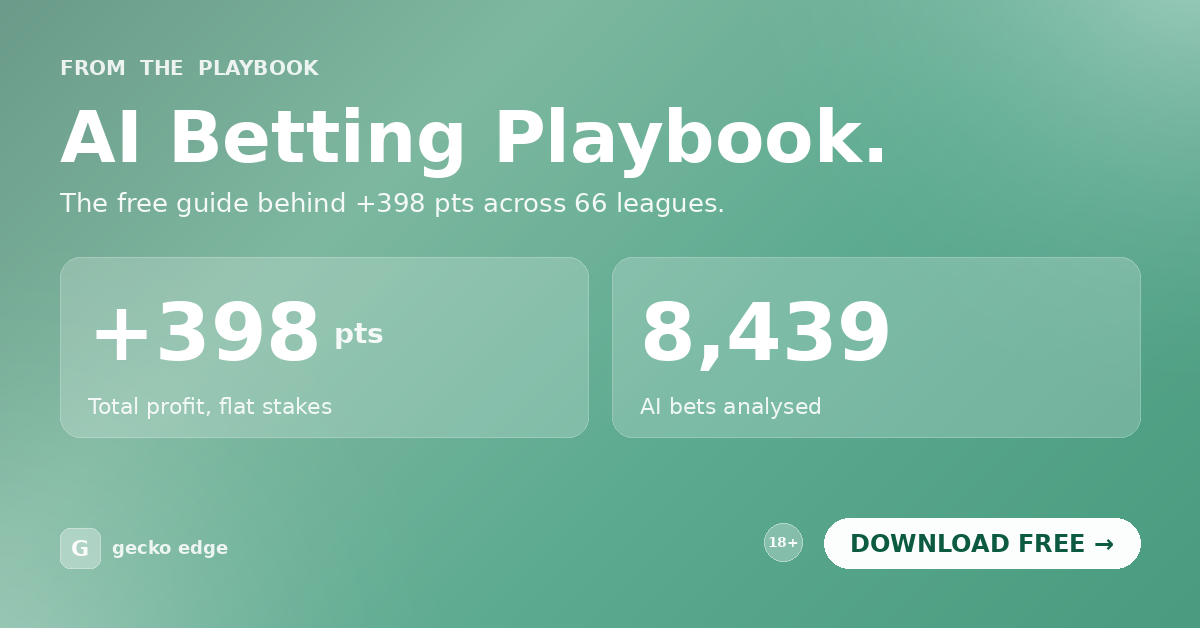
Gecko Edge has tracked 8,439 AI-generated bets and recorded +398pts of profit across 66 competitions. See how the model works →
Let me walk you through it.
Why Most Betting Systems Fail
Before we build, let’s understand why most systems collapse.
The typical punter picks teams based on gut feeling. Maybe recent form. Maybe a headline about an injured striker. It’s scattered thinking dressed up as strategy.
A proper football betting strategy requires three things:
- Data : reliable, comprehensive, and current
- Process : a repeatable method for finding value
- Discipline : the patience to trust the system
Traditional tipsters often nail the first two, then crumble on the third. Emotions creep in. One bad weekend triggers panic bets.
AI doesn’t panic. It simply calculates.
Step 1: Define What “Value” Actually Means
Here’s where most beginners stumble. They chase winners instead of value.
Value exists when the true probability of an outcome exceeds the implied probability of the odds. That’s it. Simple in theory. Tricky in practice.
Let’s say a bookmaker prices Liverpool at 2.00 to beat Nottingham Forest. That implies a 50% win probability. But your analysis suggests Liverpool wins 60% of the time. That’s value.
EV betting calculations formalise this:
Expected Value = (Probability × Potential Profit) – (Probability of Loss × Stake)
Positive EV means profitable long-term. Negative EV means you’re feeding the bookies.
Your system needs to identify positive EV situations consistently. Not occasionally. Consistently.

Step 2: Choose Your Data Sources
Garbage in, garbage out. Your predictive football models are only as good as the data feeding them.
At minimum, you need:
- Historical match results : going back several seasons
- Team and player statistics : goals, assists, possession, shots
- xG football analysis : expected goals data reveals true performance beneath the scoreline
- Contextual factors : injuries, suspensions, fixture congestion, home/away records
xG has become essential for serious bettors. A team might win 1-0 while generating 0.4 xG and conceding 2.1 xG. The scoreline lies. The data doesn’t.
Gathering all this manually? Exhausting. Hours of spreadsheets before you’ve even placed a bet.
This is where platforms like Gecko Edge change the game. The heavy lifting : data collection, processing, analysis : happens automatically. You focus on decisions, not data entry.
Step 3: Build Your Model Logic
Now for the engine of your system.
A betting model essentially answers one question: What should the true odds be for this outcome?
There are several approaches:
Regression Models
These analyse historical relationships between variables (shots on target, possession, xG) and outcomes (wins, draws, losses). They’re powerful but require statistical knowledge.
Poisson Distribution
A classic for predicting football scores. It calculates the probability of each team scoring 0, 1, 2, 3+ goals based on their attacking and defensive averages.
Machine Learning
The modern approach. Algorithms learn patterns from thousands of matches, identifying connections humans would never spot. This is where AI truly shines.
Building machine learning models from scratch demands coding skills, time, and computing power. Most beginners hit a wall here.

The alternative? Use a platform that’s already built the infrastructure.
Gecko Edge handles the technical complexity. The AI analyses fixtures using advanced predictive football models, then surfaces the value picks. You interpret the output. The system does the maths.
It’s like having a quantitative analyst on speed dial : without the salary.
Step 4: Backtest Before You Bet
Here’s where amateurs and professionals diverge.
Amateurs get excited about a new system and immediately stake real money. Professionals test rigorously first.
Backtesting means running your model against historical data to see how it would have performed. Did it find genuine value? Or did it just get lucky?
Key metrics to track:
- ROI (Return on Investment) : overall profitability as a percentage
- Strike rate : how often selections win
- Average odds : higher odds mean higher variance
- Drawdown : the worst losing streak your system experienced
A system showing 8% ROI over 1,000 historical bets tells you something meaningful. A system showing 50% ROI over 20 bets tells you nothing.
Patience here pays dividends later.
When you use Gecko Edge, backtesting data comes built-in. You can review historical performance before trusting any model with your bankroll. No guesswork. Just evidence.
Step 5: Execute With Discipline
You’ve defined value. Secured your data. Built your model. Backtested thoroughly.
Now comes the hardest part: following through.
Discipline means:
- Staking consistently : flat stakes or percentage-based, but never emotional sizing
- Ignoring short-term results : variance is real; trust the process
- Reviewing and refining : models need updates as leagues evolve
The best football betting strategy in the world fails without discipline. You will have losing weeks. Possibly losing months. The question is whether you’ll stick to the system when it hurts.
AI helps here too. It doesn’t feel the sting of a last-minute equaliser. It doesn’t chase losses. It simply identifies the next positive EV opportunity and moves forward.

A Shortcut That Actually Works
Let’s be honest. Building a complete AI-powered betting system from scratch takes months. Maybe years.
You need data pipelines, statistical expertise, coding ability, computing resources, and endless patience. Most people don’t have all five.
That’s exactly why Gecko Edge exists.
The platform combines:
- Advanced xG football analysis
- Real-time predictive football models
- Automated EV betting calculations
- Clear, actionable recommendations
No jargon. No complexity. Just smarter betting.
You still make the decisions. You still manage your bankroll. But the analytical heavy lifting? Done.
Think of it as the difference between building a car from spare parts versus driving one off the forecourt. Both get you there. One takes considerably less time.
Final Thoughts
Building an AI-powered betting system isn’t magic. It’s methodology.
Define value properly. Source quality data. Construct logical models. Backtest rigorously. Execute with discipline.
Miss any step, and the whole thing wobbles.
For beginners, the fastest path combines education with the right tools. Learn the principles, then leverage technology that handles the technical execution.
Gecko Edge was built precisely for this : giving everyday bettors access to the same AI-driven edge professionals use.
Smarter betting starts here. Not with hunches. Not with hope. With data, discipline, and a system that actually works.
Ready to stop guessing? Explore how Gecko Edge can sharpen your approach.
What does ‘value’ actually mean in betting terms?
Value exists when the true probability of an outcome exceeds the implied probability of the bookmaker’s odds. If a market prices Liverpool at 2.00 (50% implied) but your analysis suggests they win 60% of the time, you have value. The formula is EV = (Probability × Potential Profit) − (Probability of Loss × Stake). Positive EV means profitable over the long run; negative EV means feeding the bookmaker.
What data does an AI-powered betting system actually need?
At minimum: historical match results going back multiple seasons, team and player statistics (goals, assists, possession, shots), xG data showing genuine attacking output beneath the scoreline, and contextual factors like injuries, suspensions, fixture congestion, and home/away splits. Quality matters more than quantity — feeding the model garbage produces garbage out, regardless of how sophisticated the modelling is.
What modelling approach should beginners choose?
Three viable paths. Regression models analyse historical relationships between variables and outcomes — powerful but require statistical knowledge. Poisson distributions calculate probabilities of each scoreline based on attacking and defensive averages — a classic football modelling approach. Machine learning ensembles identify patterns humans miss but demand coding ability, computing resources, and time. Beginners often save time by using a platform that’s already built the infrastructure.
Why is backtesting essential before staking real money?
Backtesting runs your model against historical data to see how it would have performed. An 8% ROI across 1,000 historical bets is meaningful; a 50% ROI across 20 bets is noise. Key metrics to track: overall ROI, strike rate, average odds, and maximum drawdown (the worst losing streak). Without backtesting, you’re staking real money on a system whose true performance you don’t know yet — that’s gambling, not betting.
What does discipline mean in betting system execution?
Three habits. Stake consistently — flat stakes or percentage-based, never emotional sizing after a winning or losing streak. Ignore short-term results — variance is real and the best systems still have losing weeks. Review and refine — leagues evolve, models drift, and what worked last season may need recalibration this season. AI helps because it doesn’t feel the sting of a late equaliser; it just identifies the next positive EV opportunity.