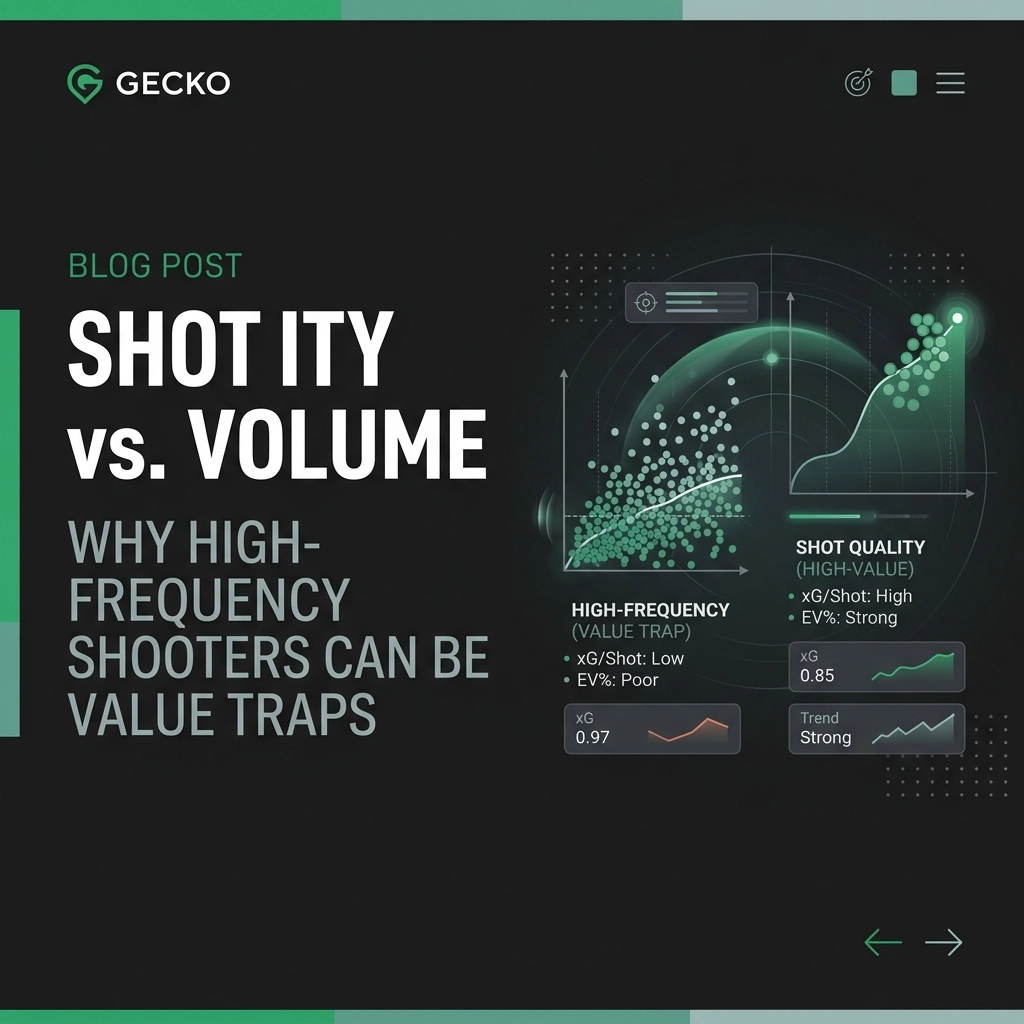
Quality; in the world of football betting, we are often seduced by activity. We see a striker who racks up five or six shots every game and instinctively think, “He’s due a goal.” The logic seems sound: more shots equals more chances, and more chances eventually lead to the back of the net.
But this is where many bettors fall into a trap. High-frequency shooting is often a mask for inefficiency. In the same way a loud engine doesn’t always mean a fast car, a high volume of shots doesn’t always mean a high-quality attacker. In fact, players who shoot constantly from sub-optimal positions are frequently “value traps”: players the market overrates because their raw stats look impressive, while their actual contribution to winning is marginal.
At Gecko Edge, we don’t just look at how many times a player pulls the trigger. We look at the “why” and the “where.” By focusing on xG per shot, we can separate the elite finishers from the “chuckers” who are simply wasting possessions.
Gecko Edge has tracked 8,439 AI-generated bets and recorded +398pts of profit across 66 competitions. See how the model works →
The Illusion of Activity
The term “junk volume” is common in weightlifting. It refers to sets and reps that make you tired but don’t actually build muscle. Football has a direct equivalent. A speculative 30-yard effort that sails into the stands counts as a shot in the box score, just like a tap-in from three yards.
If you are looking at raw “Shots per 90” data, these two actions are treated with equal weight. This is a mistake. A striker who takes five shots from outside the area is essentially a high-fatigue, low-reward asset. They are consuming team resources: the ball, time, and positioning: for a very low probability of success.
When you use the analytical tools at Gecko Edge, you start to see the game differently. You stop seeing a player who is “active” and start seeing a player who might be a liability to his team’s offensive efficiency.

Understanding Shot Quality: The xG per Shot Metric
To truly find value in the betting markets, you have to move beyond the surface. This is where xG (Expected Goals) per shot comes into play. It is perhaps the most revealing metric for any attacking player.
xG per shot tells us the average quality of the chances a player is taking. If a player has an xG per shot of 0.20, it means their average attempt has a 20% chance of going in. If another player has an xG per shot of 0.05, they are taking shots that only have a 5% chance of scoring.
Consider two strikers:
- Player A: Takes 5 shots per game, total xG of 0.25. (xG per shot: 0.05)
- Player B: Takes 2 shots per game, total xG of 0.40. (xG per shot: 0.20)
To the casual bettor, Player A looks like the bigger threat. He’s “always involved.” But Player B is the one you want to back. Player B has better movement, better decision-making, and is being found in dangerous areas. Player A is likely frustrated, taking “hopeful” shots that inflate his stats but rarely result in a goal. Gecko Edge is designed to highlight these discrepancies, ensuring you aren’t backing the “volume” when you should be backing the “quality.”
Why High-Volume Shooters Are Often Overvalued
The betting market is largely driven by public perception and mainstream statistics. If a striker is top of the “Total Shots” leaderboard, his price in the “Anytime Goalscorer” market will almost certainly be short.
The “value trap” occurs when the market fails to adjust for the quality of those shots. A high-frequency shooter who relies on long-range efforts or tight angles is a regression candidate. Eventually, the law of averages catches up. If you are consistently taking 5% chances, you are going to go on long goal droughts.
Furthermore, these players often have a negative impact on their team’s overall performance. Every time a player takes a low-quality shot, they are ending a possession that could have potentially been worked into a high-quality chance for a teammate. This is the opportunity cost of junk volume.

The Fatigue and Defensive Factor
There is also a physical and tactical limit to high-usage players. When a striker becomes the primary focus of an attack and starts taking a high volume of shots, opposing defences adjust. They close the gaps, they double-team, and they force that player into even worse positions.
A player might be highly efficient at 2 or 3 shots per game. But when that volume increases to 5 or 6, their efficiency often falls off a cliff. They get tired. Their technique wavers. They start “chasing” the goal rather than letting the game come to them. Our AI at Gecko Edge tracks these performance curves, identifying when a player’s increased involvement is actually a sign of desperation rather than dominance.
Separating the Engines from the Mirages
So, how do you tell if a high-frequency shooter is the real deal or just a mirage? You look for specific indicators of elite quality.
- Proximity to Goal: Are the shots coming from inside the “danger zone” (the width of the six-yard box)?
- Shooting Consistency: Does the player maintain a high xG per shot even as their volume increases?
- Big Chance Involvement: Is the player getting “big chances” (chances with an xG over 0.30) or are they just padding their stats with speculative efforts?
Players like Erling Haaland or prime Robert Lewandowski are exceptions because they maintain incredible shot quality even at high volumes. They aren’t just shooting more; they are getting open more. Most strikers cannot do this. Most strikers who increase their shot volume see their shot quality plummet.
By using the The Ultimate Guide to xG Stats, you can begin to build a profile of which attackers are sustainable and which are simply having a “busy” but unproductive season.

How Gecko Edge Filters the Noise
In a fast-paced betting environment, you don’t have time to manually calculate the xG per shot for every player in the Premier League. This is why we built Gecko Edge. Our AI does the heavy lifting, processing thousands of data points to provide you with a clear picture of attacking value.
We look for the “hidden” shooters: the players who might only take two shots a game, but those shots are consistently high-value. These are the players who offer real betting value because the market often overlooks them in favour of the high-volume “names.”
When you look at our AI Betting Playbook, you’ll see that our strategies are built on this principle of efficiency. We aren’t interested in who is making the most noise; we are interested in who is making the most impact.
Final Thoughts: Quality Over Quantity
Betting on football is about finding the gap between what the numbers say and what the truth is. Raw shot totals are a loud, distracting number that often hides the truth about an attacker’s efficiency.
Next time you see a striker with ten shots in his last two games, don’t automatically assume he’s a good bet. Ask yourself: Where did those shots come from? Were they forced? Were they desperate?
Smarter betting starts with better data. By focusing on shot quality and xG per shot, you can avoid the value traps and find the real engines of offensive production. Whether you are looking at the Asian Handicap or the goalscorer markets, let Gecko Edge guide you toward the quality.
Don’t be fooled by the volume. The most dangerous player on the pitch isn’t always the one shooting the most; it’s the one who knows exactly when to shoot.


1 comment