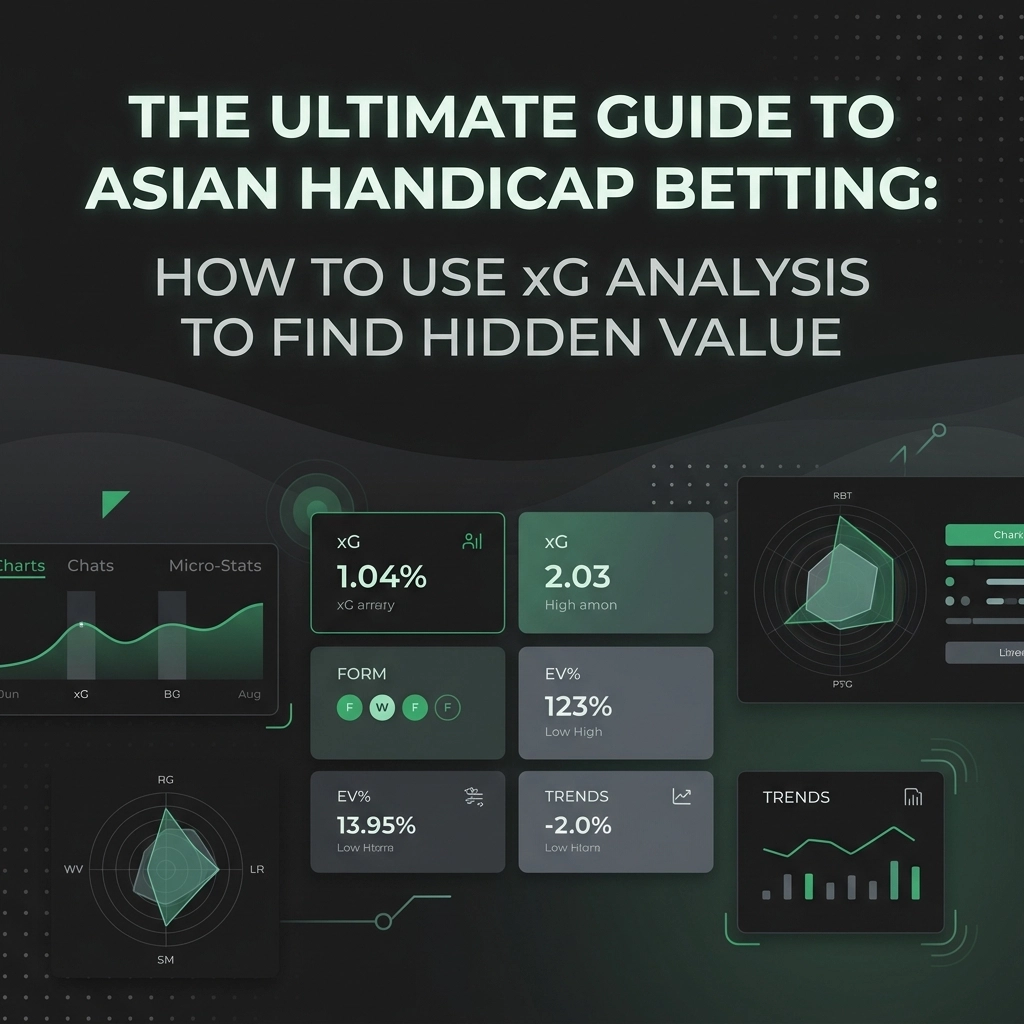
Asian Handicap; most bettors approach a football match with a simple question: “Who will win?”
Professional traders ask a different one: “What is the probability of this specific margin, and does the price reflect it?”
Traditional 1X2 markets are popular, but they are often inefficient. They account for three outcomes, including the draw, which can frequently swallow a well-researched bet in the final minutes. This is why the Asian Handicap (AH) has become the gold standard for serious bettors. It simplifies the game, removes the draw, and offers a more surgical way to back a team.
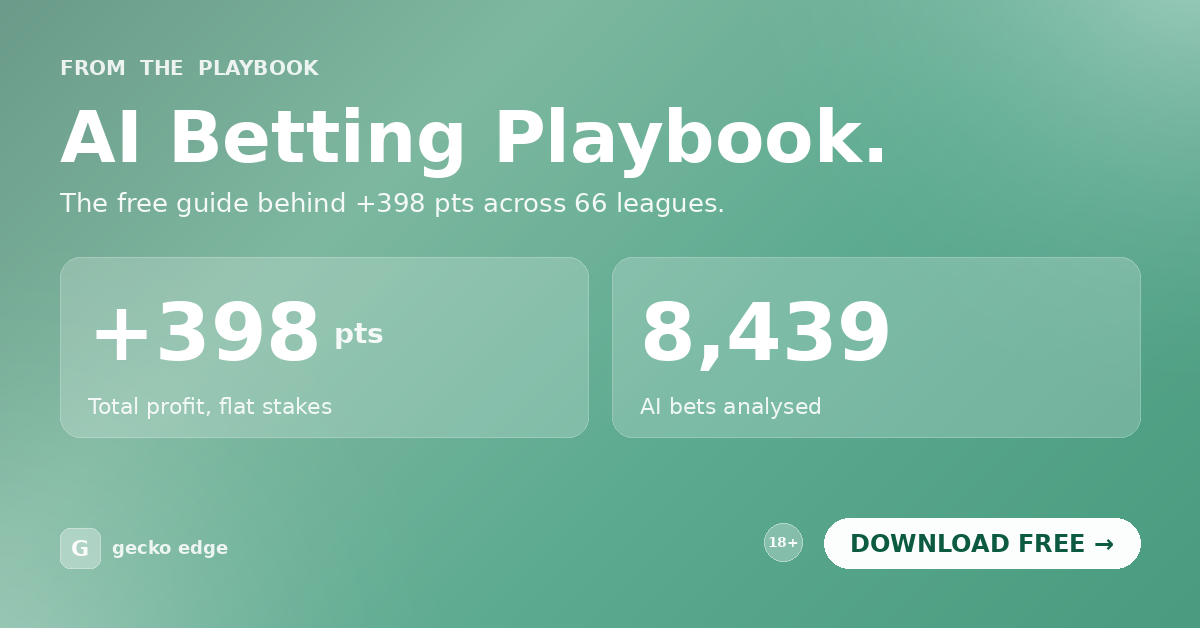
Gecko Edge has tracked 8,439 AI-generated bets and recorded +398pts of profit across 66 competitions. See how the model works →
But to win consistently at Asian Handicap, you need more than just a gut feeling about team form. You need a data-driven lens to see through the noise of final scores. That lens is Expected Goals (xG).
At Gecko Edge, we believe that smarter betting starts with technology. By combining xG analysis with Asian Handicap markets, you aren’t just guessing; you are calculating.
Understanding the Asian Handicap: The Professional’s Choice
The Asian Handicap is a market that levels the playing field by giving a virtual goal advantage or disadvantage to teams before the whistle even blows. By doing this, it essentially turns a three-way market (Win, Draw, Loss) into a two-way market.
If a match is perfectly balanced, the handicap might be 0.0 (often called “Draw No Bet”). If one team is a heavy favourite, the handicap might be -1.5 or -2.0.
The beauty of AH lies in its precision. You aren’t just betting on a win; you are betting on the efficiency of that win. Whether you are backing a favourite to dominate or an underdog to keep it close, the AH market offers better liquidity and lower bookmaker margins than almost any other football market.
For a deeper dive into the terminology, our Knowledge Base Betting Glossary covers the specific mechanics of quarter-ball and half-ball lines.

The xG Factor: Why Final Scores Lie
Football is a low-scoring sport. Because of this, it is prone to extreme variance. A team can dominate a match, create five “big chances,” and still lose 1-0 to a deflected long-range shot.
If you only look at the final score, you might think the losing team is out of form. If you look at the xG, you realise they were actually superior.
Expected Goals (xG) measures the quality of every shot taken in a match based on historical data. It assigns a value: usually between 0.01 and 0.99: to represent the likelihood of that shot becoming a goal.
When you use xG analysis, you stop chasing the “result” and start betting on the “process.” This is essential for Asian Handicap betting because the AH is all about margins. If a team consistently generates an xG of 2.5 but only scores 1.0, the market may undervalue them in the next match. That is where the hidden value lives.
To understand the fundamentals of these statistics, read The Ultimate Guide to xG Stats.
Calculating the Line: AH Meets xG
To find value, you must first create your own “fair” handicap line and compare it to the bookmaker’s offering. The basic formula for an xG-based Asian Handicap calculation is:
AH = Expected Goals Against (Underdog) – Expected Goals For (Favourite)
Or more simply:
AH = xG (Team B) – xG (Team A)
Let’s say Manchester City is playing Brighton. The bookmaker sets the line at Manchester City -1.5.
You look at the data provided by Gecko Edge and see that over the last five matches, City’s attacking xG is 2.8 per game, while Brighton’s defensive xG allowed is 1.1. Conversely, Brighton’s attacking xG is 1.2, and City’s defensive xG is 0.7.
By calculating the difference in these performance metrics, you might conclude that the “true” line should be -2.0. If the bookie is offering -1.5, you have found value on the favourite. They are expected to win by a larger margin than the market suggests.

Finding Value in the Underdog
One of the most profitable ways to use xG in Asian Handicap markets is identifying “unlucky” underdogs.
Consider a mid-table team that has lost three games in a row by a single goal. The general public: and the bookmakers: will often push their handicap higher (e.g., from +0.5 to +1.0) because the “form” looks terrible.
However, if your xG analysis shows that in those three losses, the team actually won the xG battle but suffered from poor finishing or world-class goalkeeping against them, they are a prime candidate for a positive handicap bet.
Luck eventually regresses to the mean. When a team’s performance (xG) is significantly higher than its results (actual goals), the “bounce back” is often imminent. Taking a +1.0 or +1.25 AH on such a team allows you to profit even if they draw or lose narrowly, capitalizing on a market that overreacted to a streak of bad luck.
Match Tempo and Handicap Tightness
xG is a volume metric. To find value in Asian Handicaps, you must also consider the “tempo” of the game.
- High-Tempo Matches: In games where both teams play an expansive style, the xG totals will be higher. This creates more “variance” in the scoreline, making wider handicaps (like -1.75 or -2.0) more viable.
- Low-Tempo Matches: In games where a team “parks the bus” or both teams are defensively structured, the total xG will be low. In these scenarios, even a small handicap like +0.75 is incredibly valuable because goals are at a premium.
Gecko Edge uses AI to identify these tactical trends, helping you decide whether a specific handicap is “safe” based on the projected number of scoring opportunities in the match.

The Professional’s Checklist: Ask, Analyse, Act
Before placing an Asian Handicap bet based on xG, follow this disciplined workflow:
1. Ask: Is the market reacting to noise or reality?
Check the recent results of both teams. Are the scores reflective of the play? A 3-0 win might look dominant, but if the xG was 0.8 to 0.7, that team was lucky. They might be “priced to perfection” in the AH market, making them a trap.
2. Analyse: Look at xG for and against
Don’t just look at total xG. Look at home/away splits. Some teams are xG giants at home but struggle to create away from home. Use the Gecko Edge AI platforms to get processed, clean data that filters out meaningless shots.
3. Act: Select the line that protects your stake
One of the advantages of Asian Handicap is the “half-win” or “half-loss” (on 0.25 and 0.75 lines). If your xG analysis suggests a close game, don’t be afraid to take the +0.25 or +0.75 to give yourself a safety net.

Why AI is the Ultimate Edge
The challenge with xG is that it is historical. To predict the future, you need to process thousands of data points simultaneously: injuries, weather, tactical shifts, and historical xG trends.
Doing this manually for every match is impossible for a human bettor. This is why Gecko Edge was built. We use AI to do the heavy lifting, identifying matches where the Asian Handicap line is out of sync with the underlying performance data.
We don’t promise miracles; we provide clarity. We show you where the numbers point so you can make an informed, professional decision.
Final Thoughts: Built For Bettors, Powered By AI
Asian Handicap betting is a game of margins. xG analysis is the tool that defines those margins.
By looking past the scoreline and focusing on the quality of chances, you move away from the “gambler” archetype and toward the “analyst” archetype. You begin to see the football pitch as a series of probabilities rather than a series of highlights.
If you are ready to stop guessing and start calculating, explore our Knowledge Base or see how our models work at Gecko Edge.
Smarter betting starts here. Ask the right questions. Analyse the right data. Act with confidence.
Q1: What is Asian Handicap betting?
Asian Handicap is a football betting market that eliminates the draw by giving one team a virtual goal advantage or deficit. The favourite starts with a handicap (e.g. -1.5 goals); the underdog with a head start (e.g. +1.5). Bettors then back which team will “win” the match once the handicap is applied. The structure produces two outcomes instead of three, which typically delivers tighter margins and better value than traditional 1X2 markets.
Q2: How does Asian Handicap work?
Each side is assigned a goal handicap, expressed as a positive or negative number. To settle the bet, the handicap is added to the team’s actual score. A team backed at -1.5 must win by 2 or more goals; a team backed at +1.5 wins the bet if they win, draw, or lose by 1. Half-goal handicaps eliminate any chance of a refund, while whole-goal handicaps (e.g. -1) refund the stake when the result lands exactly on the handicap.
Q3: What do quarter-line Asian Handicaps mean (0.25, 0.75)?
Quarter lines split your stake across two adjacent half-goal handicaps. A -0.75 bet, for instance, splits your stake between -0.5 and -1.0. If your team wins by 2 or more, both halves win. If they win by exactly 1, the -0.5 half wins and the -1.0 half refunds, returning a half win. This structure gives bookmakers more pricing precision and offers bettors more granular ways to express an edge.
Q4: How do you find value in Asian Handicap markets using xG?
The strongest approach is to model match outcomes independently using xG and shot quality data, then compare your implied probability for each goal margin against the bookmaker’s pricing. Asian Handicap markets typically carry smaller bookmaker margins than 1X2, which means smaller pricing inefficiencies translate into actionable +EV bets. Cross-referencing xG-derived goal probabilities with current AH lines often surfaces hidden value the broader market hasn’t priced in.
Q5: Why do sharp bettors prefer Asian Handicap over traditional 3-way markets?
AH markets carry smaller bookmaker margins (typically 2-3% versus 5-8% on 1X2), so bettor edge translates into profit more efficiently. They also remove draw risk, which is the hardest 1X2 outcome to model accurately. Combined with the granularity of quarter and half lines, AH gives modellers more ways to express conviction at the optimal price point. Gecko Edge’s analytics treat AH as a primary market for value extraction, with a heavy AH share across the 8,439 +EV bets tracked over 66 competitions.

7 comments